
Want to grow longer, thicker hair – fast? While there’s no overnight solution for fast hair growth and improved thickness, this homemade hair growth oil can speed up the process. Infused with herbs and essential oils, this natural hair growth oil recipe was born out of years of experimenting with the best ways to grow long hair fast. It’s effective, all-natural, and easy to make at home.
There are a lot of “fast hair growth secrets” out there, some effective, and some not so much. And I probably tried most of them!
Wanting to grow longer, thicker hair naturally was one of the things that piqued my interest in natural beauty in the first place. So like all my homemade beauty recipes, this DIY hair growth oil came from my own personal experience.
I often spent hours in my teen years browsing specialty stores for herbs and supplements, religiously reading the Long Hair Care Community forums, and trying all sorts of hair growth tips and home remedies in my efforts to grow hip-length hair.
In hindsight, I wish I’d spent less time on superficial pursuits. But it wasn’t all a time wasting endeavor, because trying just about everything for hair growth helped equip me with the discernment I have today. And you need to be extra discerning in order to navigate today’s beauty industry.
So whether you’re trying to reduce hair loss, promote regrowth after a period of stress, or simply want a boost to help grow your hair longer and faster, I hope this hair oil recipe will help you achieve your goals.
Why I made this homemade hair growth oil
My hair has been through a lot. I’m by no means an expert, but I’ve grown longer hair a couple times over in the past decade. So I have a little bit of knowledge and experience of what works to grow long hair fast.
The full story of my hair growth journey is a little too long for this post, and if I would’ve known I’d be blogging about it years later, I would’ve documented it a lot better!
I’ve never enjoyed taking photos, but I did manage to find this one from years back – I was in the midst of growing out dark brown henna and starting the transition back to blonde.
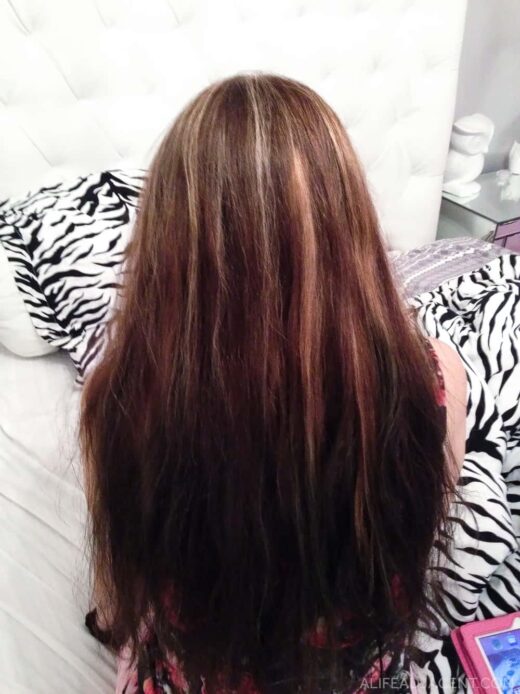

As for where I am now, to be honest, my hair doesn’t look its absolute best. I take good care of it, so it’s in decent condition despite being lightened, but it thinned out quite a bit due to recent life stress (which is apparent in my hair’s ends, unfortunately).
I’m currently trying to regain some length and thickness, so it was the perfect time to revisit my best growth tips, including this DIY hair growth oil. If you’re in a similar situation, we’re in it together, and I’ll update later once I’ve made more progress.
I really enjoy using this hair oil – it’s very soothing to the scalp, and its silky texture helps soften dry ends. The gentle tingle of peppermint and rosemary essential oils is also incredibly refreshing, and makes you feel like it’s working.
And since it’s well known that stimulating scalp circulation promotes faster hair growth and thickness, I think it’s safe to say that the tingle does mean it’s working.
Can oils really help grow your hair faster?
Hair growth is big business. There’s seemingly always a new, exotic “fast hair growth oil” or magic serum guaranteed to give you the long, mermaid hair of your dreams.
But the truth is that most carrier oils simply don’t have any magical hair growth properties. Using too much of the wrong oil can even promote yeast overgrowth, making hair loss and scalp issues worse.
Take argan oil for instance – at one point, it was the miracle hair growth oil du jour. But in reality, its fatty acid profile is nothing special, and closely resembles sesame oil or sunflower oil – neither of which help to grow hair. (And this is coming from someone who used to use argan oil religiously!)
That said, there are a few oils that truly do promote hair growth and thickness, which I’ll get into. And they can be made even more effective by adding certain herbs and essential oils (such as rosemary, peppermint, and a few others) to make your own hair growth oil.
DIY hair growth oil benefits + how it works
This homemade hair oil helps grow long hair naturally in a few ways:
- Stimulates scalp blood flow. This hair oil recipe is infused with potent herbs and essential oils that stimulate blood flow to the scalp and hair follicles.
- Modulates hair growth phase. Castor oil stimulates prostaglandin pathways implicated in the growth phase, which speeds up hair growth1.
- Reduces scalp buildup. Massaging your scalp with a hair oil before washing helps loosen buildup that can clog hair follicles and slow growth. It’s the same idea behind using a face cleansing oil to keep pores clear.
- Antioxidant activity. The antioxidants in this DIY hair oil support faster growth by protecting the hair follicle and hair shaft from oxidative stress2.
- Antimicrobial activity. Bacteria and yeast overgrowth can lead to conditions such as dandruff, scalp acne, and seborrheic dermatitis, which can contribute to slow growth and hair fall2. But the antibacterial herbs and essential oils in this recipe, such as rosemary oil, help keep the scalp flora in check.
Now that we’ve covered the basics, let’s get into how to make your own hair oil for growth.
Fast Hair Growth Oil Ingredients
You’ll need only a few ingredients for this recipe:
- Heat stable carrier oil for herbal infusion
- Cold-pressed castor oil
- Dried, organic hair growth herbs
- Growth-boosting essential oils
- Vitamin E oil
You can choose to make this DIY hair growth oil with essential oils, herbal infusion, or both. I like to use both in order to take advantage of the full spectrum of benefits in the entire plant.
But if you don’t have time for herbal infusion, you can make an easy hair oil by simply mixing the carrier oils with the essential oils for growth recommended below. More detailed instructions to follow.
Heat stable carrier oil
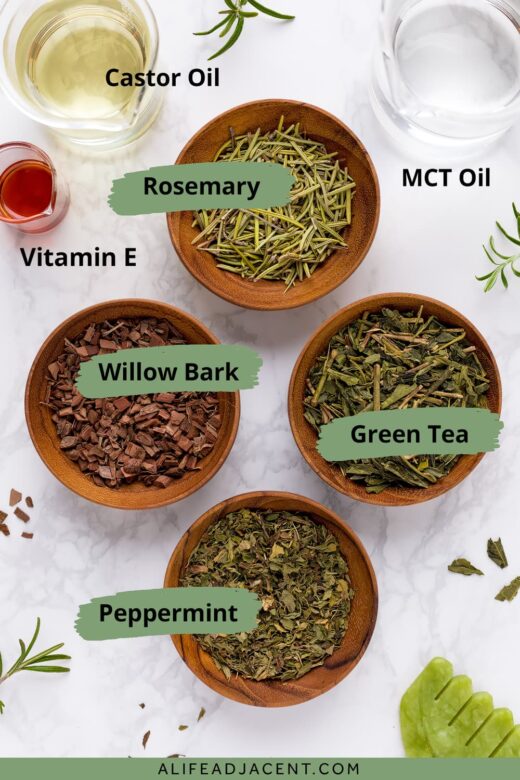
The first thing you’ll need is a stable carrier oil to use during the infusion process. Options include:
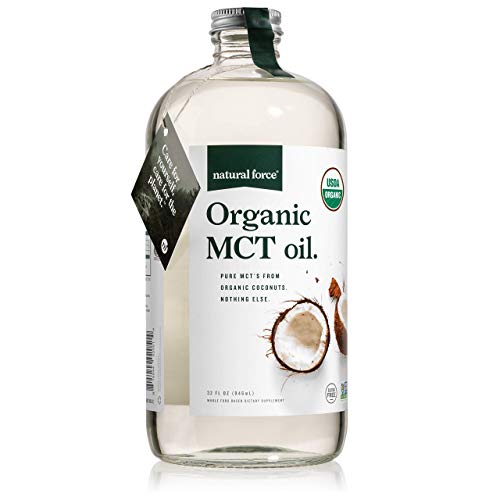
- MCT oil (medium chain triglyceride oil)
- Fractionated coconut oil (liquid coconut oil)
- Avocado oil
- Jojoba oil
- Olive oil
What constitutes a stable oil, and why is using one to make hair growth oil so important?
Many of the most common oils used for herbal infused oils, such as sweet almond oil, sunflower oil, and safflower oil, are extremely high in unstable polyunsaturated fatty acids (PUFAs).
PUFAs are extremely volatile. They break down and oxidize during heat and light exposure, ruining the oil’s beneficial qualities. This is where many herbal infusions go wrong, and unfortunately, using rancid polyunsaturated oils may even contribute to skin aging.
The solution is to use monounsaturated or saturated oils. Both options are more heat-stable, with saturated fatty acids being the most stable of all.
I prefer to use MCT oil or fractionated coconut oil for my herbal infusions, but you can use any of the oils recommended above. We’ll be careful to not overheat the oil and oxidize its delicate fatty acids.
MCT oil in particular will not feed Malassezia yeast, a species of yeast that lives on our skin and can cause fungal acne, folliculitis, and seborrheic dermatitis. So if you have issues with yeast overgrowth, a scalp oil with MCT oil may work best for you.
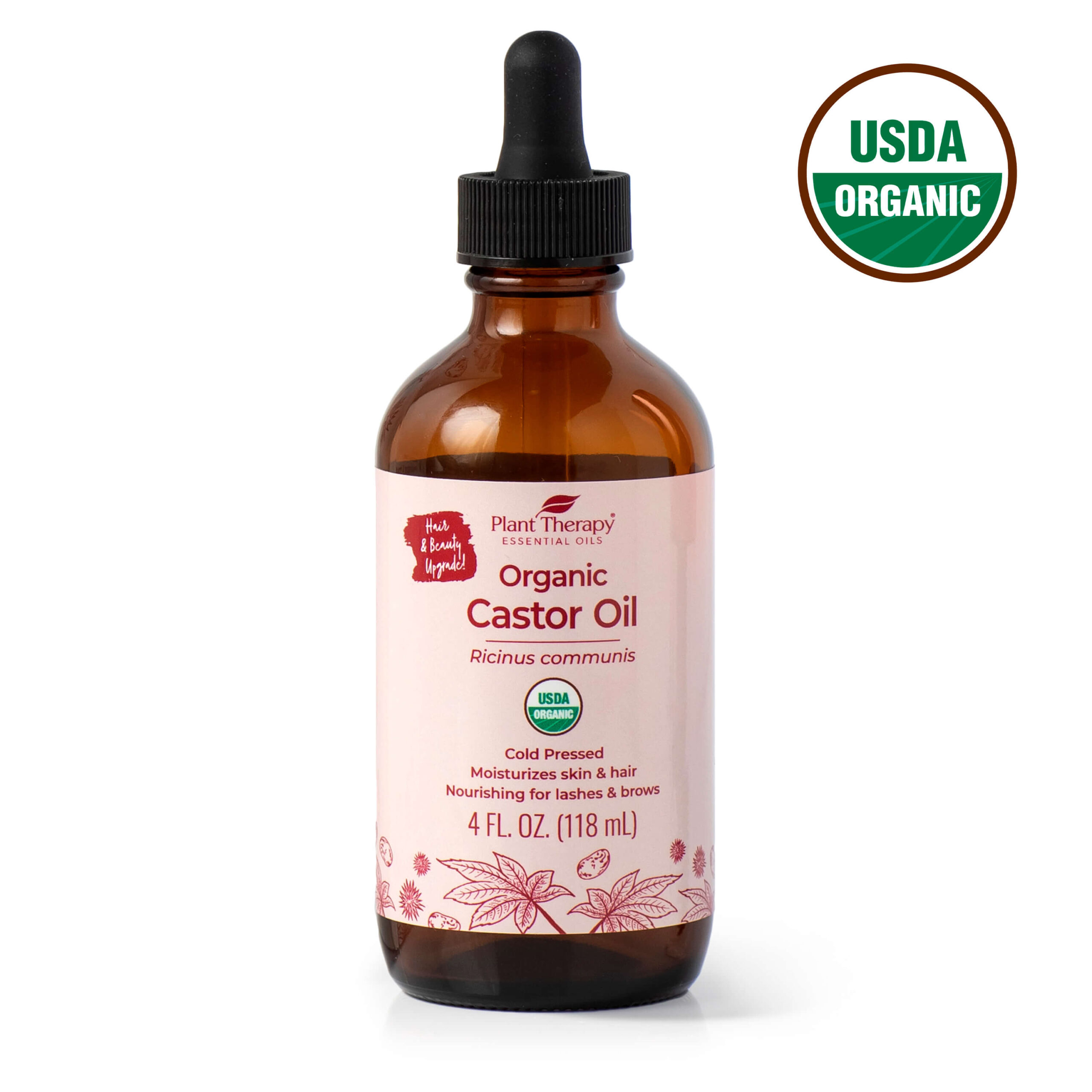
Castor oil
Once you make the herbal infused hair oil, the next step is to dilute it with castor oil.
There’s a lot of hype around castor oil – and healthy skepticism is always warranted. But castor oil is one of those hair growth tips that truly does live up to its claims.
I did a deeper dive into castor oil for hair growth in my post on eyelash growth serum, as I’ve used it to grow my lashes longer and thicker over the years.
But to sum up, castor oil has certain qualities that make it a true fast hair growth oil, including:
- Prostaglandin-like activity that lengthens the active hair growth phase while delaying the resting phase1
- Conditioning properties that helps prevent hair follicles from drying out3
- Moisturizing qualities to help protect existing hair from breakage
- Antibacterial and anti fungal effects to keep the scalp healthy
- Rich in antioxidants such as vitamin E, which are essential for protecting the hair follicles from oxidative damage
Hair growth herbs
There are a variety of herbs that are said to boost hair growth, thickness, and strength. You could easily go overboard with 10 different herbs to create the ultimate hair growth potion.
Below, I’m highlighting only a few of the most effective herbs, which helps keep this herbal hair oil recipe easy to follow. These are rosemary, peppermint, white willow bark, and green tea.
If desired, you can also simply use 1 or 2 herbs. You can also replace the dry herb with its respective essential oil. For instance, use rosemary essential oil instead of making rosemary infused oil.
Finally, each herb was selected for its oil soluble benefits. Some well-known hair growth ingredients such as caffeine, biotin, and silica are water soluble, meaning they aren’t compatible with infused oils.
Other herbs that may be helpful for growing long hair include stinging nettle, horsetail, red clover, onion, yarrow, and ginseng. These aren’t included in this hair growth oil recipe, but you may wish to research them for your own use.
Rosemary
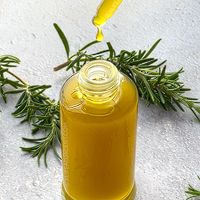
There’s a reason rosemary infused oil is one of the most popular homemade hair growth remedies.
Rosemary has been shown to be just as effective as minoxidil (hair loss medication), but without any of the undesirable side effects4. Another win for natural remedies!
Rosemary’s benefits for hair growth are threefold. It works first by stimulating blood flow to the scalp – this revitalizes the hair follicles and makes more nutrients available for growth.
Not only does rosemary stimulate existing hairs to grow, but it also stimulates new growth, increasing overall hair thickness.
Rosemary oil’s antibacterial and antifungal properties are also well-established. This is helpful for hair and scalp health, since bacteria and yeast overgrowth are associated with excess itching and hair fall5.
Finally, rosemary is also extremely rich in antioxidants, which protect our skin and hair from oxidative stress. Stressed hair follicles can’t grow quality hair – in fact, lower antioxidant levels are associated with premature hair loss2.
Peppermint
Peppermint’s cooling, soothing, and pain-relieving properties make it a favorite ingredient for dandruff shampoo and products formulated for irritated scalps.
But it does more than soothe the scalp. Peppermint was found to significantly increase hair growth, perhaps even more so than rosemary6.
Topical peppermint essential oil at 3% strength was found to be more effective than minoxidil. It significantly sped up the hair growth phase while increasing the number of hair follicles – in other words, peppermint oil promotes longer, thicker hair.
Aside from its effects on growth, peppermint is also anti-inflammatory, anti fungal and antimicrobial, qualities that help support a healthy scalp.
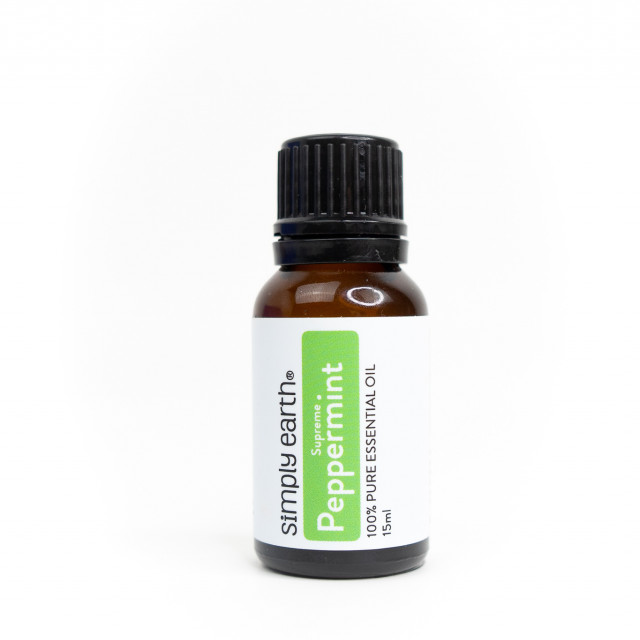
For best potency, I use GC/MS tested peppermint supreme oil for my hair growth oil.
Note: peppermint oil was studied on mice, but the results were nonetheless impressive. In the study’s own words, it induced very thick and long hair, and many anecdotal accounts also support peppermint’s efficacy for fast hair growth.
White willow bark
If you struggle with scalp issues such as dandruff, seborrheic dermatitis, or pesky scalp pimples, white willow bark is a helpful addition to your homemade hair growth oil.
Willow bark has been used for thousands of years as a natural remedy for pain and inflammation7. Its potent effects are attributed to salicin, a natural anti-inflammatory, analgesic, and gentle exfoliant.
Willow bark and its derivatives (such as salicylic acid) are also commonly used in psoriasis and anti-dandruff shampoos, scalp serums, and other scalp-soothing treatments.
So what does this have to do with hair growth and thickness? While salicin has not been shown to stimulate growth directly, it helps support scalp health, which is integral to healthy hair growth.
Willow bark helps soothe the skin, relieve a sore or itchy scalp, and gently unclog pores and hair follicles. Its exfoliating properties can also help reduce scalp buildup, acne8, plaque, and dandruff.
And since salicin is oil-soluble, you can trust that its benefits will be released during infusion and end up in your finished product.
Green tea
Last but not least, green tea leaves are an optional step for those who would like to add an extra dose of antioxidants to their homemade hair oil.
Green tea’s benefits are often attributed to caffeine and ECEG9, both of which possess impressive hair growth effects. However, neither are oil soluble, so they won’t make their way into an infused oil.
But green tea infused oil is still chock full of antioxidants that support growth and hair follicle health. Our bodies are constantly fighting off an onslaught of oxidative stress, so it helps to have extra support.
Note: green tea gives the hair growth oil a deep, dark green color. I have blonde hair and don’t find staining to be an issue, but if you’re worried about green tea staining your hair, you can skip it.
Vitamin E oil for fast hair growth
On the topic of antioxidants, vitamin E is another ingredient that belongs in any effective hair growth oil (or lash and brow growth serum).
In a study on rabbits, topically applied pure vitamin E significantly accelerated hair growth10. Like rosemary and peppermint, vitamin E stimulates scalp blood flow and hair follicle microcirculation, which is an important factor in promoting fast hair growth and thickness.
As a bonus, vitamin E helps stabilize your carrier oil during heat infusion. This is actually vitamin E’s main biological purpose in the body – to protect unsaturated fatty acids from oxidation11, which is why it’s the body’s most important fat soluble antioxidant. I also take a supplement for extra hair support.
For best results, choose a vitamin E oil with a spectrum of mixed tocopherols.
Essential oils for hair growth
You can also add essential oils to your herbal hair growth oil for even more concentrated, potent benefits.
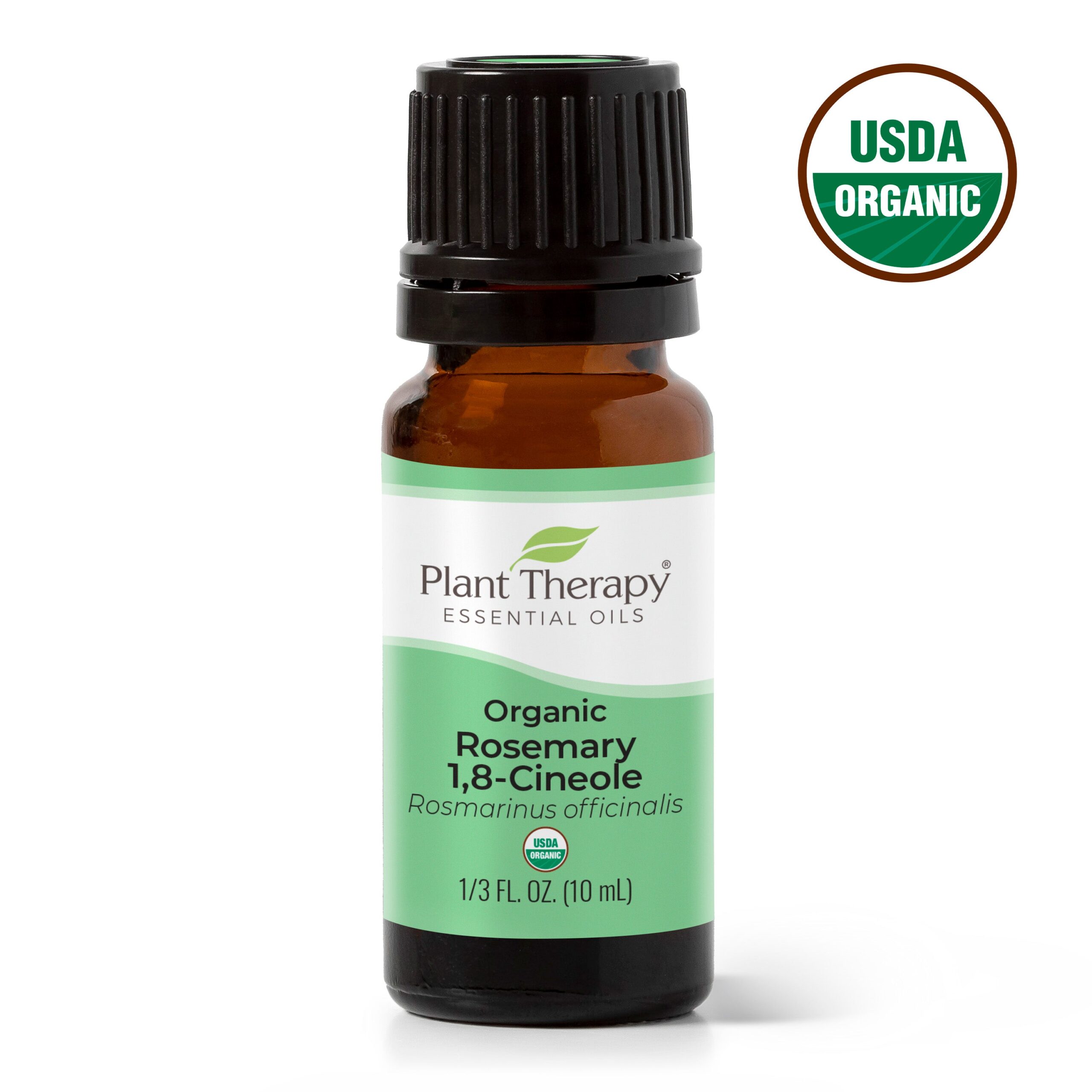
In terms of the best oil mixture for hair growth and thickness, peppermint and rosemary essential oils are two of the most effective. It’s not yet clear as to whether rosemary oil or peppermint oil is better for hair growth, so for good measure, I use both in my recipe.
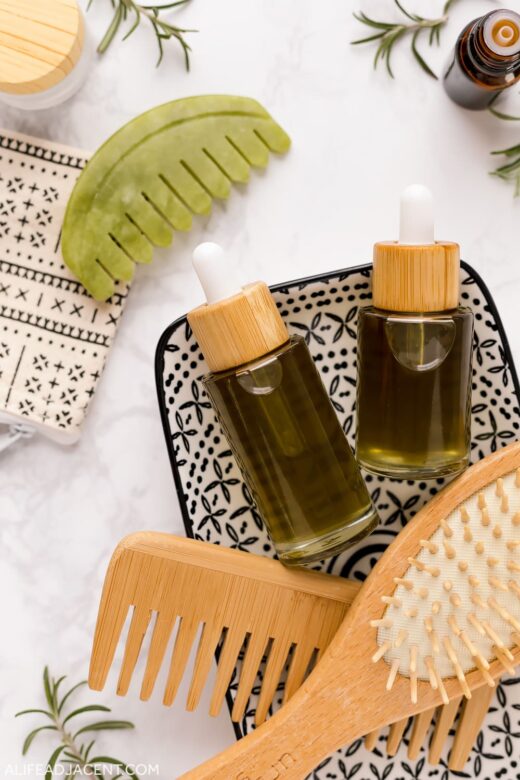
If you’d to to create your own essential oil blend for hair growth, cedarwood12, lavender, thyme13, frankincense14, myrrh, palmarosa15 and nettle16 essential oils are also associated with hair growth and/or improved scalp health.
Aside from peppermint and rosemary, I also like adding an essential oil blend called Beauty Within to my scalp treatments and homemade hair masks, as it contains several of the best antifungal oils to support scalp health.
Homemade hair growth oil notes
Before you make your hair oil, here are a few notes about the process, shelf life, and tips for packaging.
Tips for making hair oil at home
- Please use only dried organic herbs for your herbal infusion. Fresh herbs contain water, which harbors mold and bacteria. You don’t want to end up with a moldy, rancid herbal hair oil!
- Making herbal infused oils is not always an exact science. Dry herbs absorb oil, so you don’t know how much you’re going to lose during infusion. I recommend using 1 cup carrier oil for the herbal oil. You’ll end up with extra infused oil, but you can set it aside for a future batch, or make extra to gift to a friend.
- There are a few steps to making this recipe: making the concentrated herbal infused oil, diluting it with castor oil, and adding the essential oils. The castor oil is added separately to avoid damaging its delicate fatty acids.
How to dilute rosemary and peppermint oil for hair growth
- This hair growth oil recipe contains 6% rosemary and peppermint essential oils, or approximately 200 drops (7ml). However, drops are not an accurate measurement, so for best accuracy, please weigh your essential oils with a 0.01g scale.
- To dilute rosemary and peppermint oil for hair, it’s important to stay within the recommended range. According to Tisserand and Young17, rosemary essential oil’s dermal maximum is between 6.5%-22%, depending on the type of rosemary oil, while peppermint essential oil’s dermal maximum is 5.4%.
Packaging, storage, and shelf life
This recipe makes 100g hair growth oil (approx 1/2 cup or 4oz).
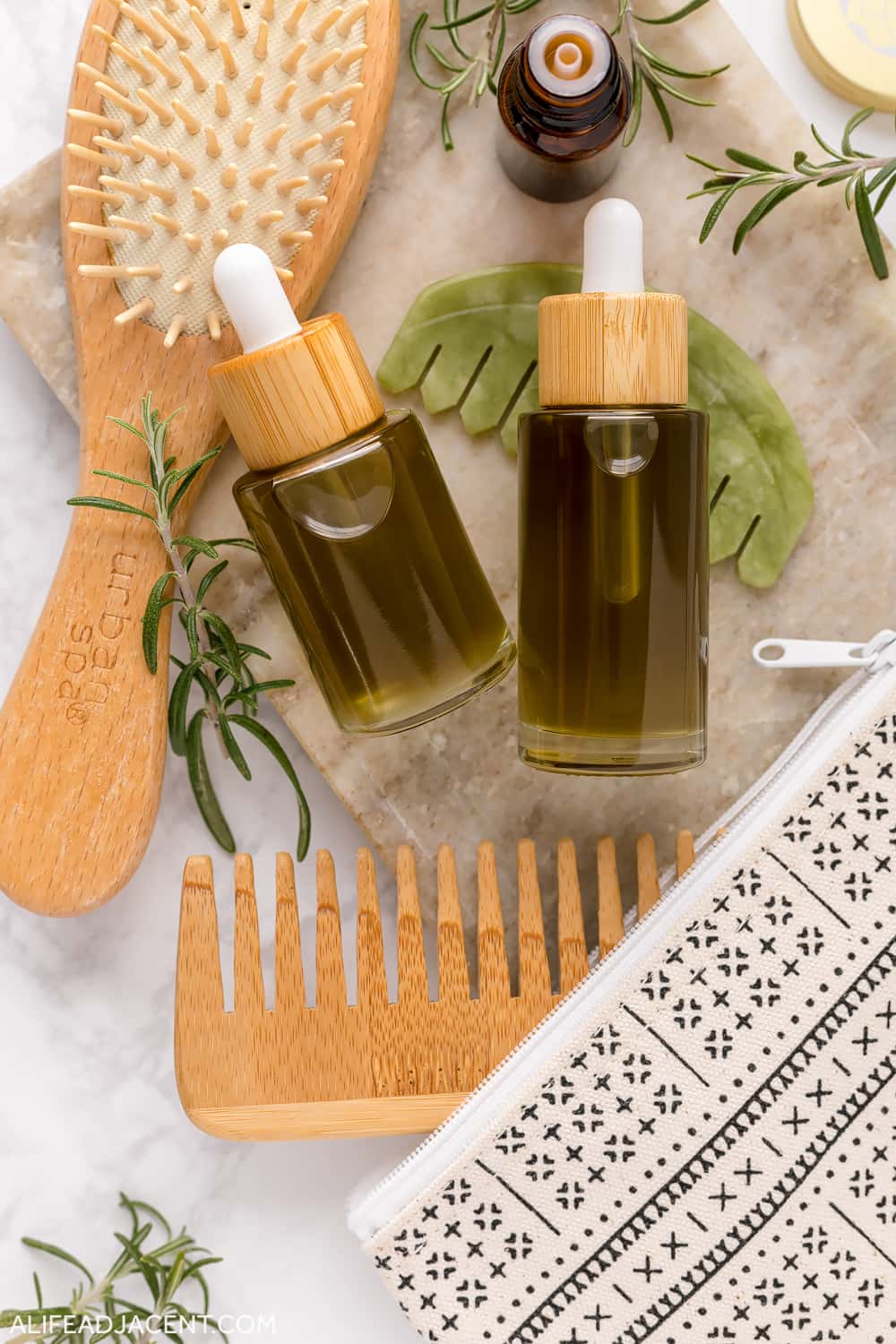
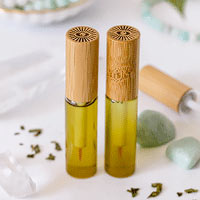
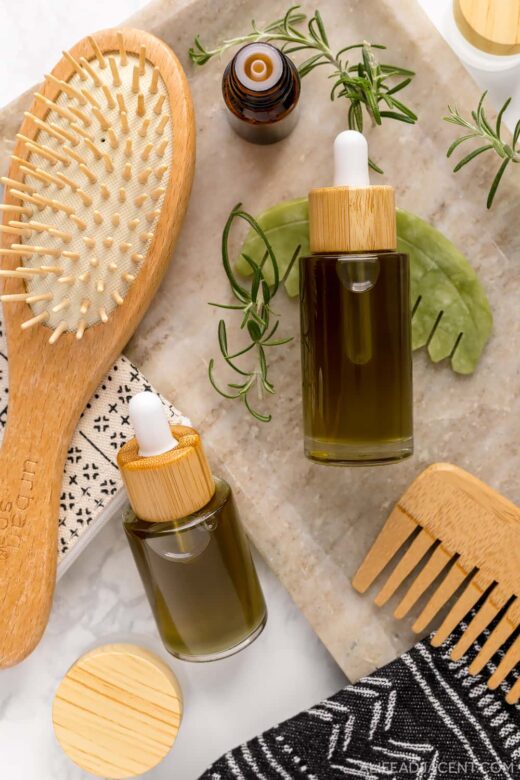
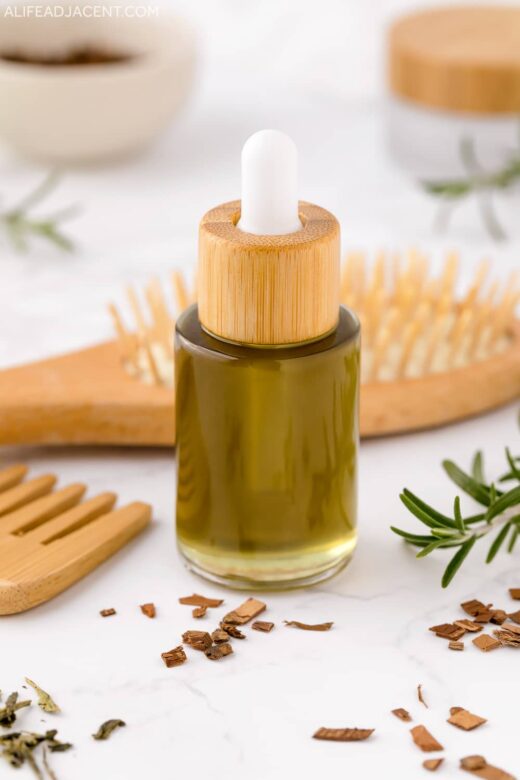
Glass dropper bottles are best for packaging hair oils, as a dropper makes it easy to apply the oil directly to the scalp, giving you a targeted application.
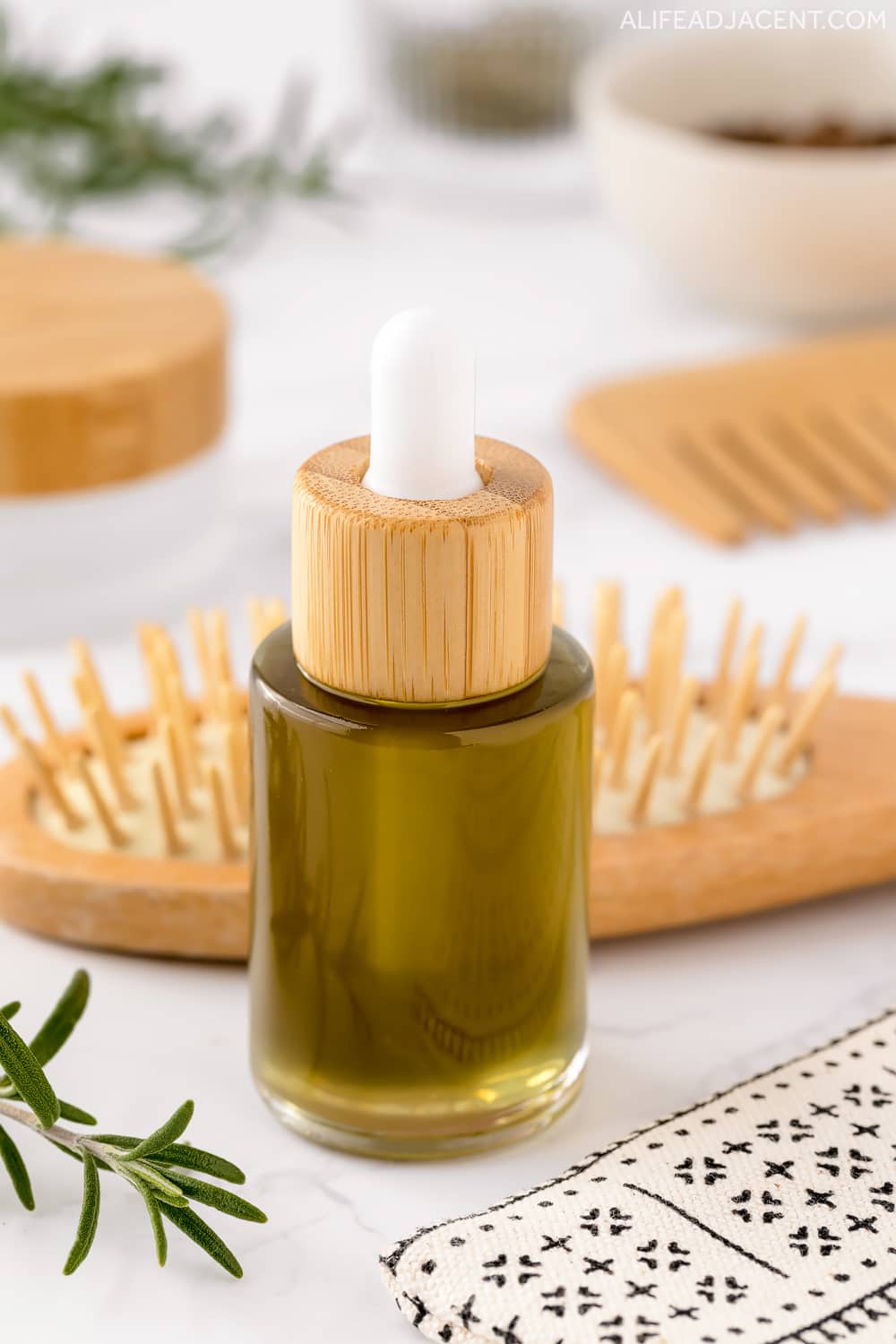
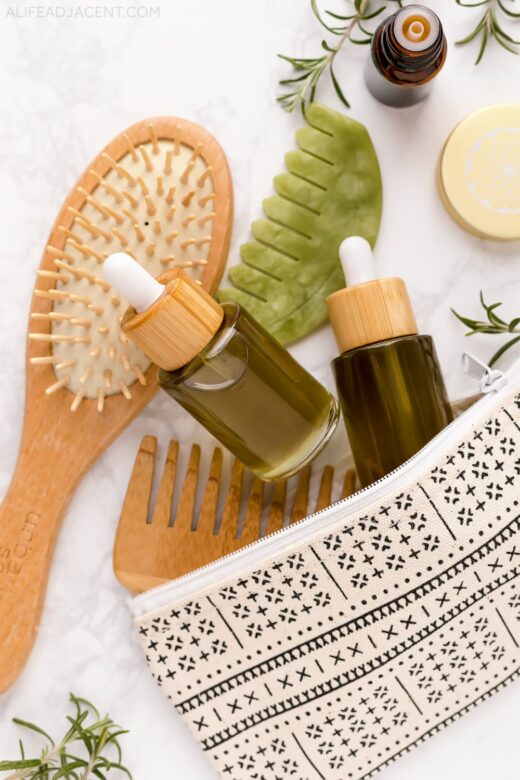
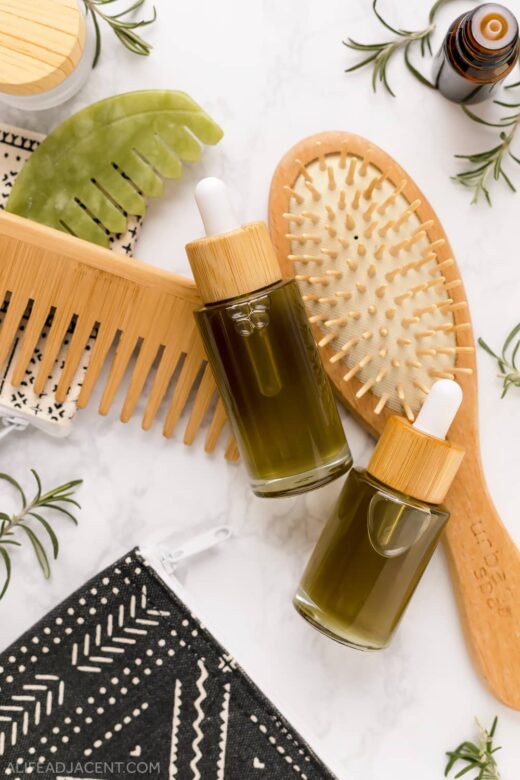
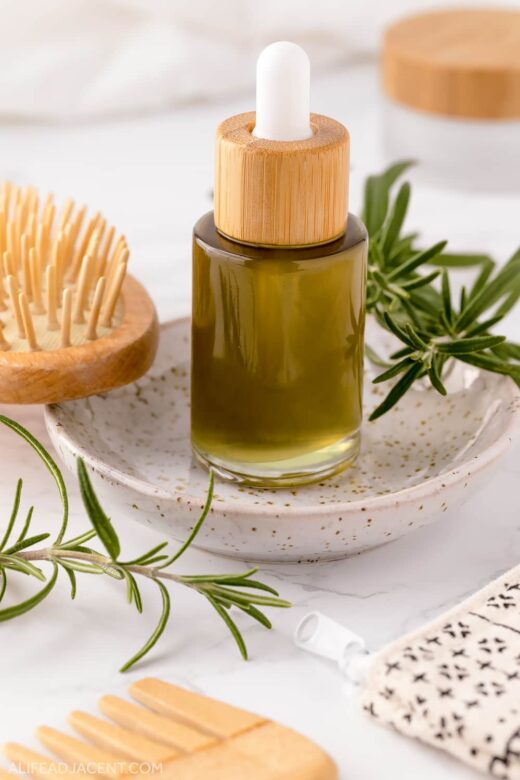
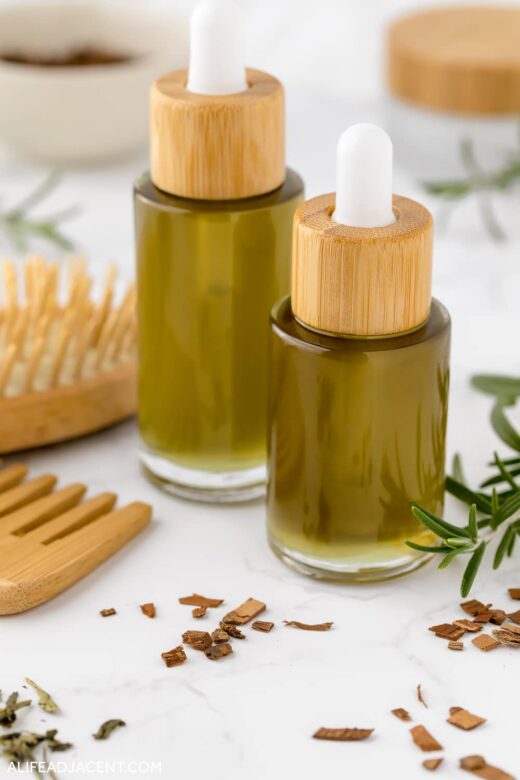
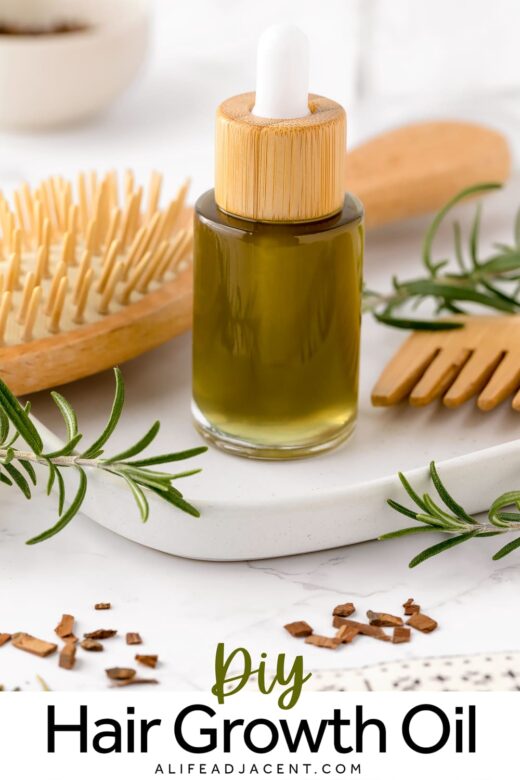
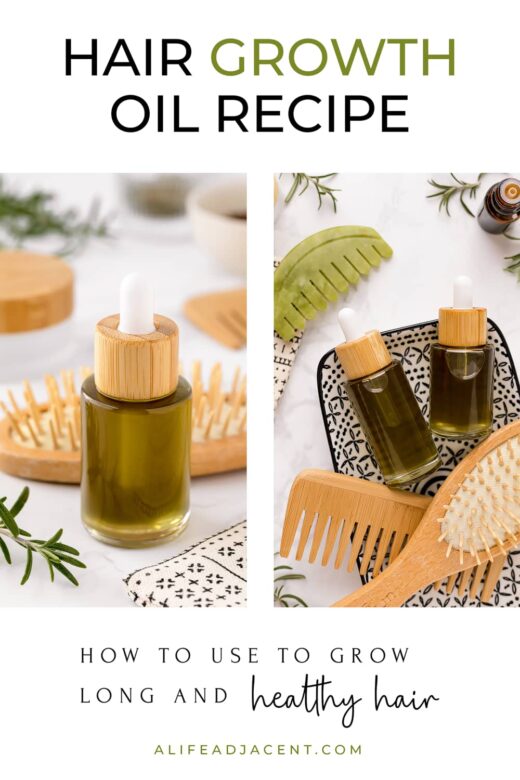
A dark colored glass dropper bottle is preferable to protect the oil from light. You can still use a clear glass and bamboo dropper bottle like the one shown in the photos, but please be sure to store it in a dark cupboard (which you should do anyway).
Use your homemade hair growth oil within a year for best potency, however, it can last up to 2 years or more depending on your carrier oil’s shelf life and freshness. The vitamin E also helps lengthen its shelf life.
Equipment for making DIY hair oil
You’ll need the following equipment for this recipe:
- Kitchen scale to weigh ingredients
- Heat-proof glass mason jar lid
- Slow cooker (other methods below)
- Tea towel for even heat distribution
- Laser thermometer
- Sieve or cheesecloth to strain herbs
- Glass dropper bottle for application
However, to make the simple hair oil with essential oils, you’ll need only a glass dropper bottle – instructions below.
Finally, please note that you don’t have to use a slow cooker or mason jar to make this DIY. You can also infuse the hair oil with your preferred method, such as using a stovetop double boiler, butter warmer, or Turkish coffee pot on low heat.
Safety information
- The herbal infused oil you’ll be making is very concentrated, so I recommend diluting it with castor oil as per the instructions before use.
- Please note that this hair growth oil is highly effective, but it’s also very strong. Discontinue use if you experience any irritation, and do not use on an injured scalp.
- Please be very careful during application. Do not let the hair oil run onto your forehead or face. Essential oils can cause serious skin irritation or injury if they get into your eyes.
- Finally, please note that herbs and essential oils may not be safe for everyone. In particular, willow bark can interact with certain medications. Like with all internet beauty recipes, it’s up to you to use your discretion and consult your doctor to see whether this hair growth oil is safe for you.
- Discontinue use immediately if your experience any skin or scalp irritation.
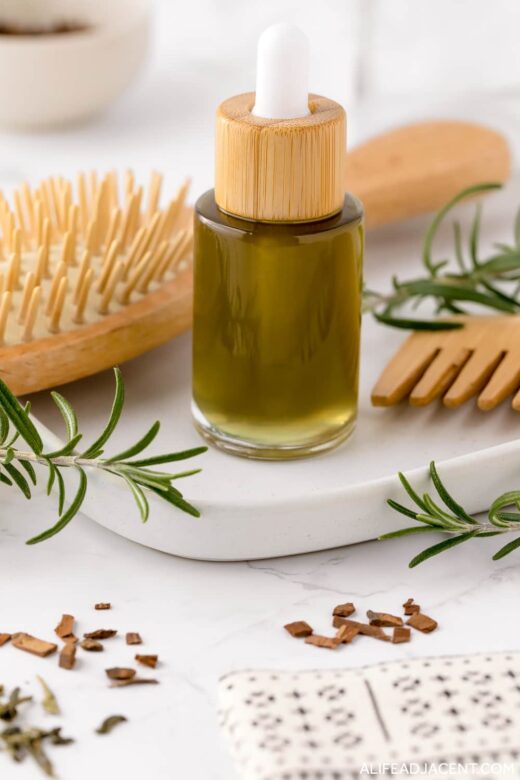
DIY Hair Growth Oil Recipe
47g herbal infused oil (instructions below)
47g castor oil
3.5ml / 3g peppermint essential oil
3.5ml / 3g rosemary essential oil
Herbal Infused Oil
1 cup / 200g carrier oil, such as MCT oil, olive oil or avocado oil
~3/4 cup dry herbs, such as rosemary, willow bark, peppermint, and green tea
5ml / 1 tsp / 4g vitamin E oil
How to make hair growth oil
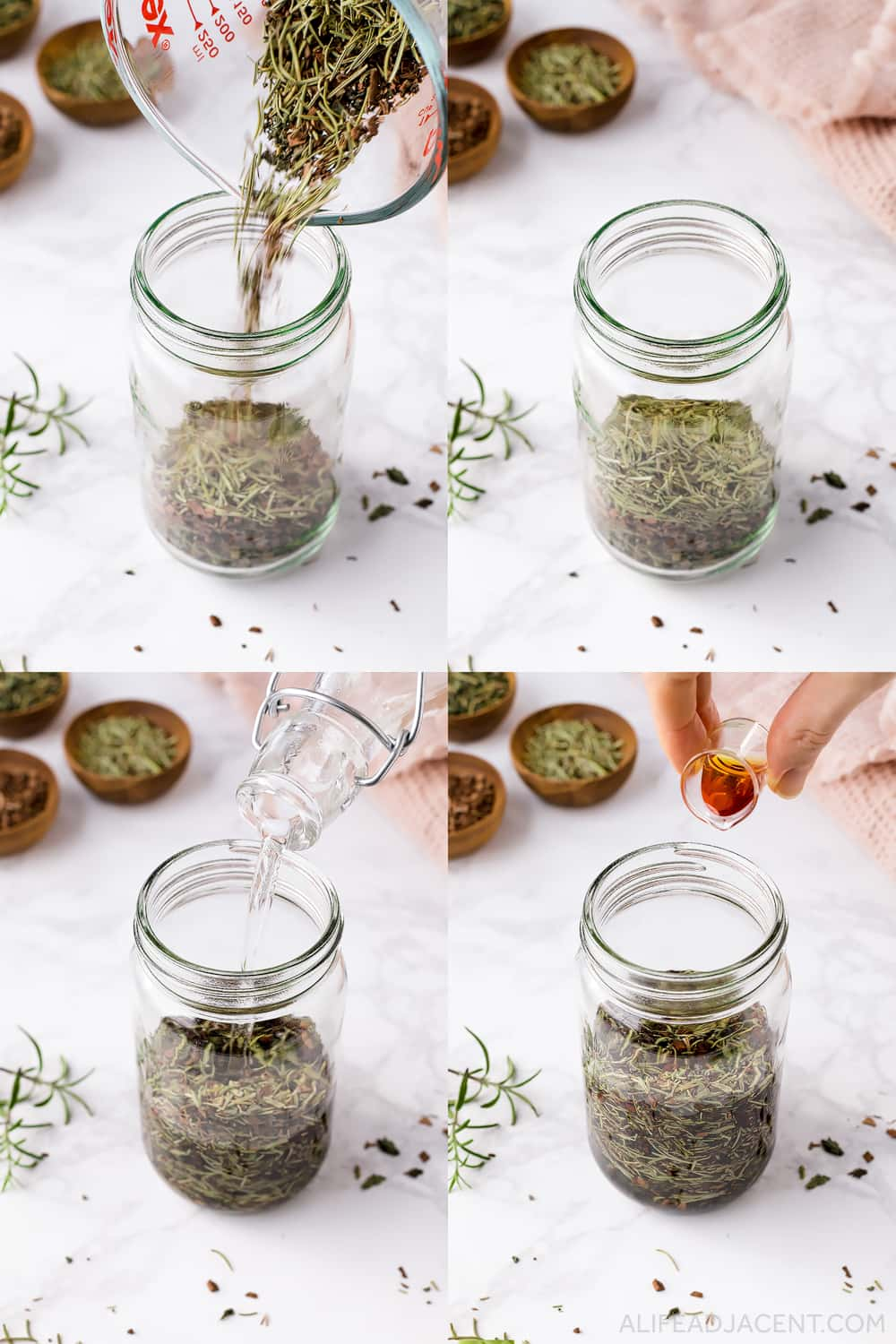
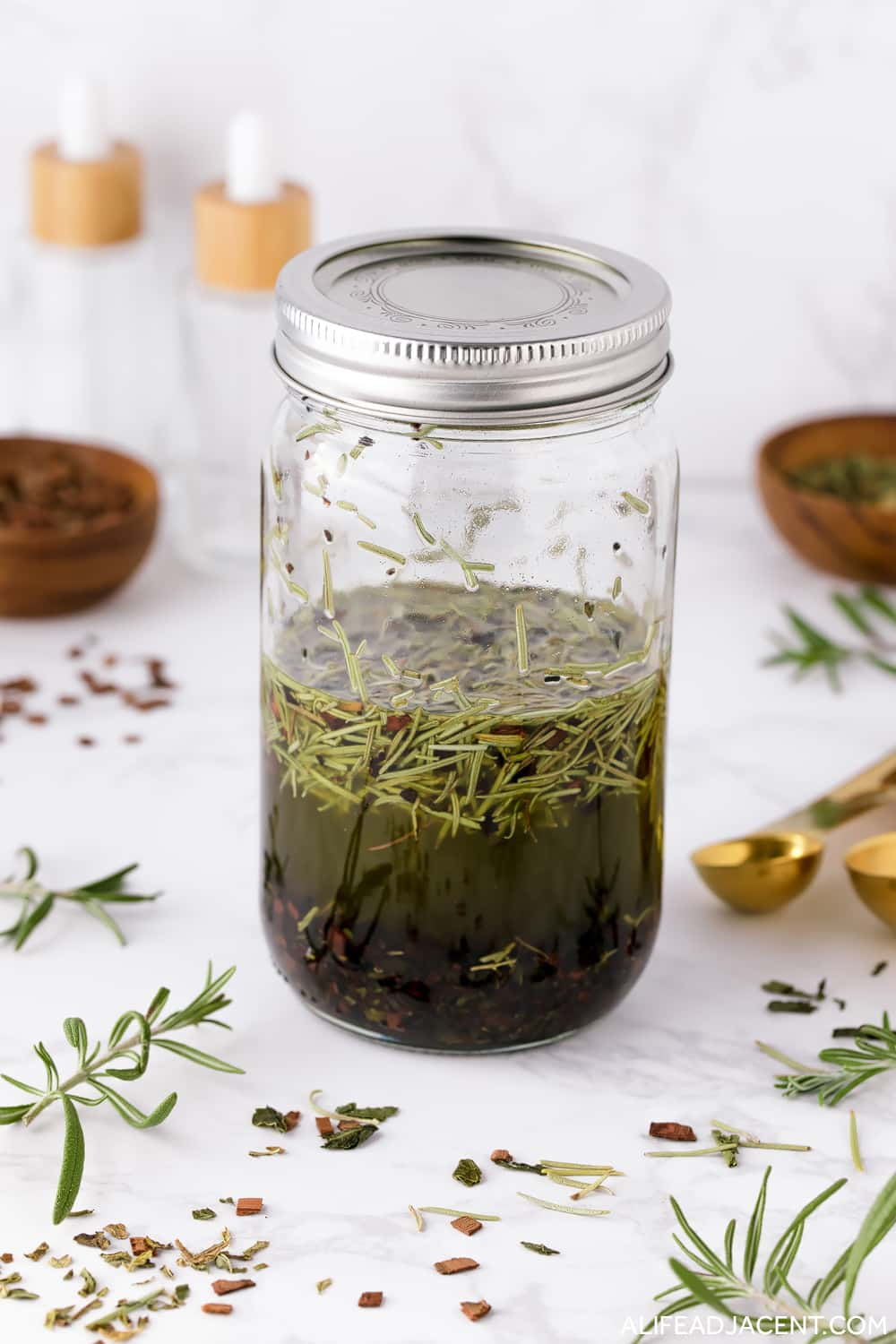
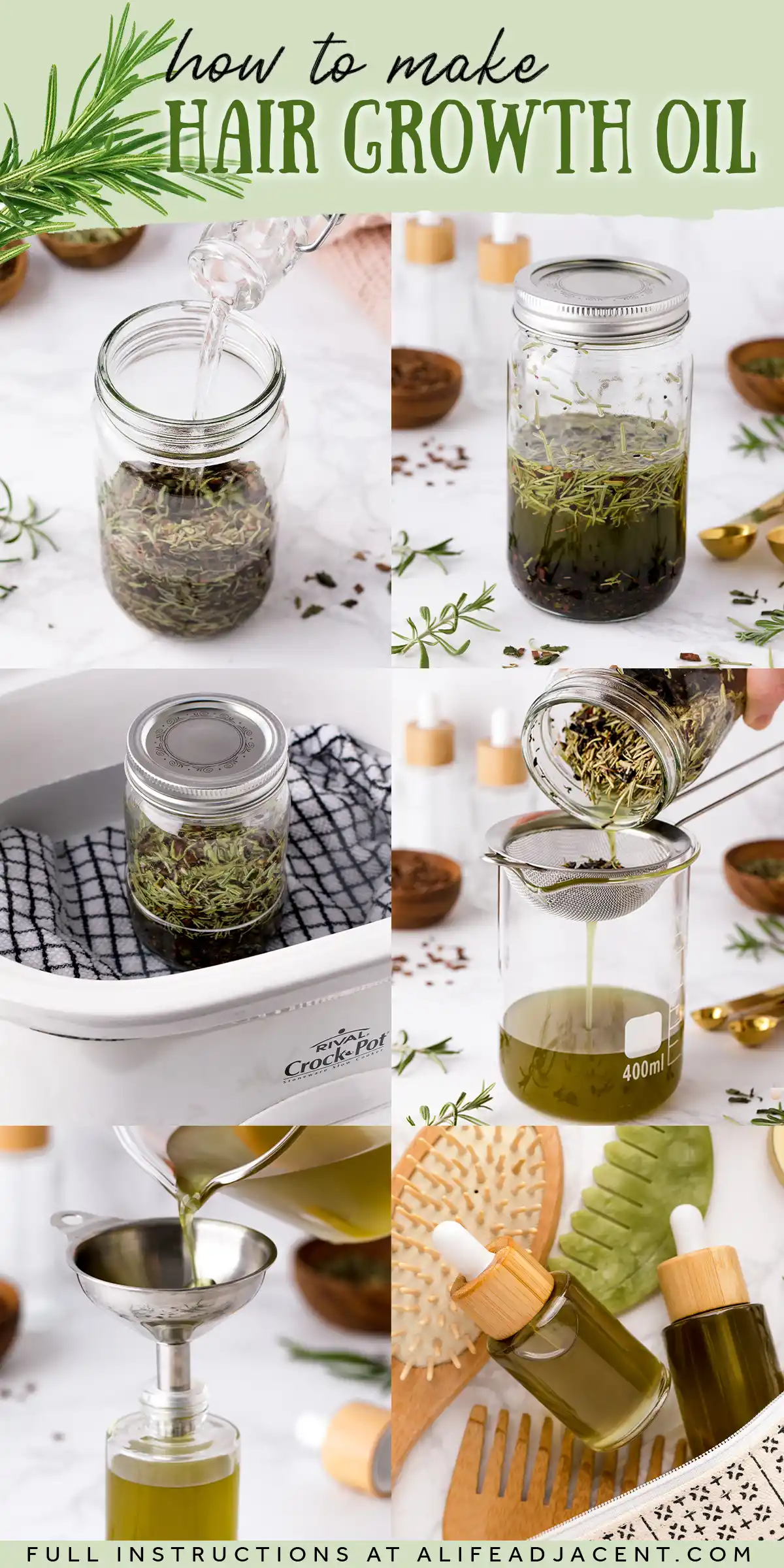
- Place the hair growth herb blend into a clean, heat-proof mason jar. Pour the carrier oil over top to cover the herbs, then add vitamin E oil.
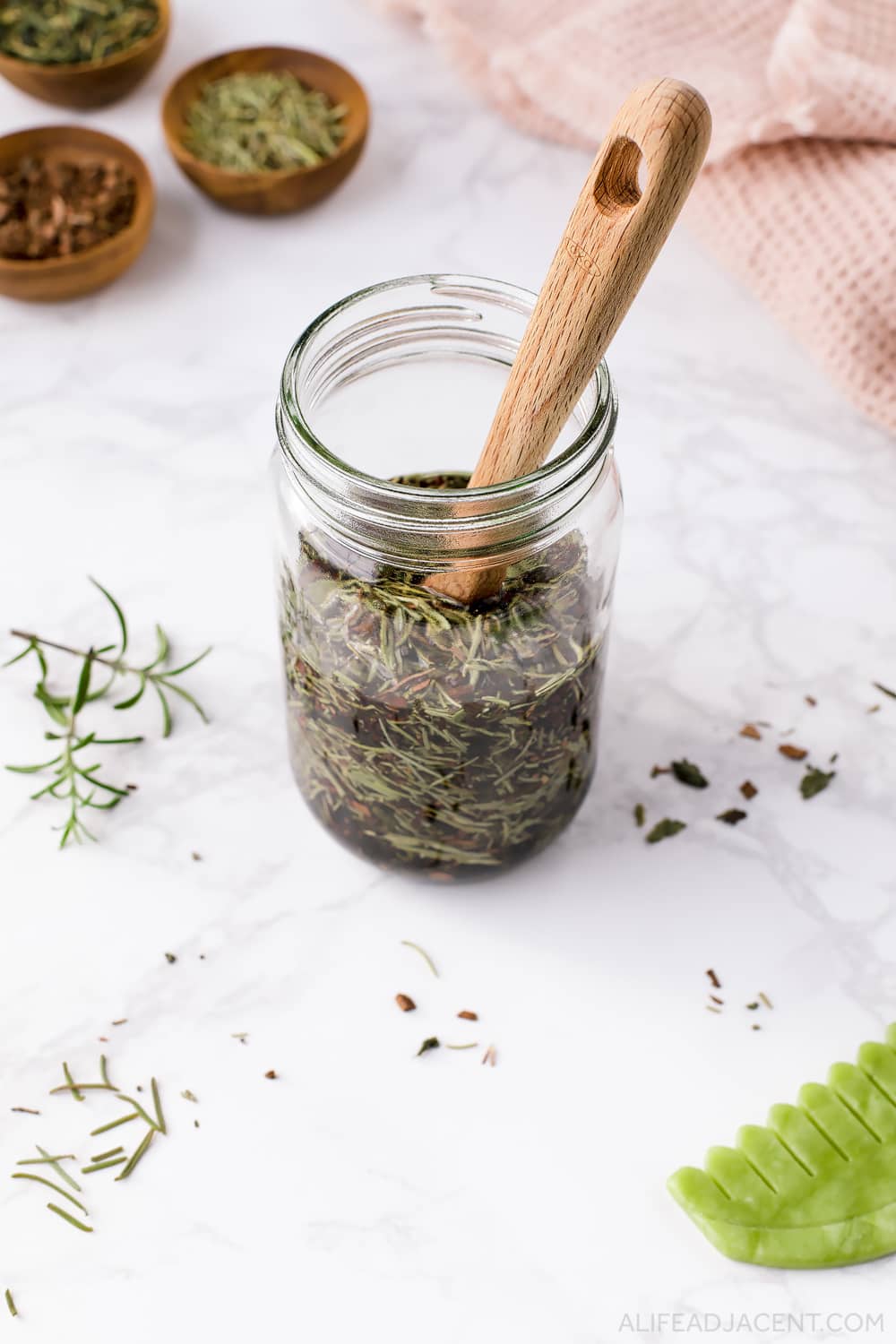
- Use a wooden spoon to mix the contents of the jar, pushing the herbs down until they’re evenly covered in oil. Then, seal your mason jar with a metal lid. Make sure it’s a one-piece lid to prevent water or steam from leaking inside.
- Prepare your slow cooker by placing a hand towel at the bottom. This prevents the jar from directly contacting the hot bottom, ensuring better heat distribution. Fill the slow cooker with water, adjusting the water level as needed. You want just enough water to submerge the jar without allowing water to leak inside.
- Lower the jar of oil into the water and replace the slow cooker’s lid. Using the slow cooker’s lowest setting, allow the hair growth oil to infuse anywhere from 8-12 hours.
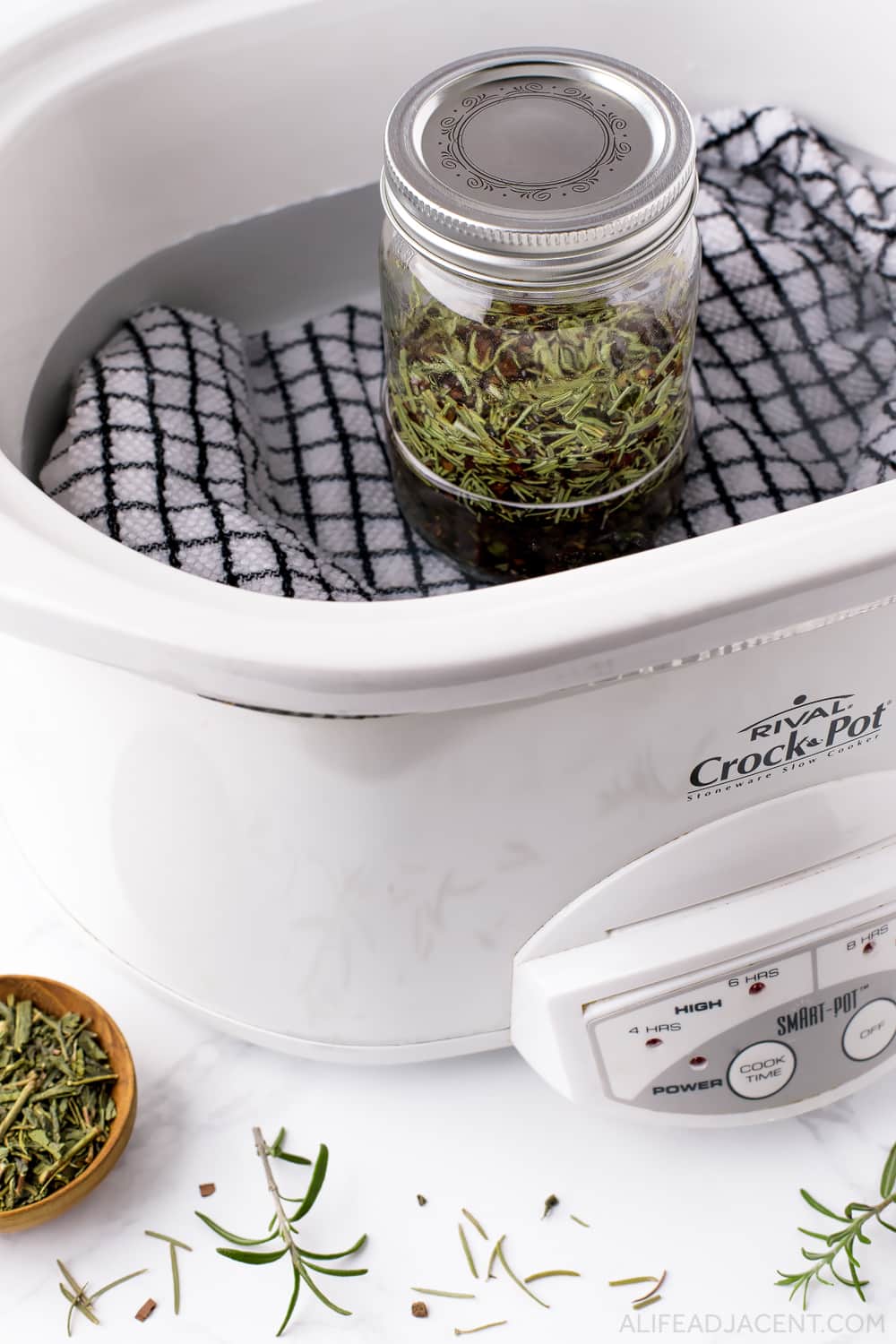
Tip: Settings vary across slow cookers, so it may be difficult to control the exact water temperature. But to avoid scorching the oil or herbs, try to keep the water temperature between 50°C-71°C (120-160°F). A laser thermometer makes monitoring easy. If the water starts to get too hot, you can remove the slow cooker’s lid to offshoot some heat, or turn the unit off altogether. However, MCT oil is very heat stable, so don’t panic if you overheat your oil – it’s okay to reach a maximum of 110°C (230°F). - Once the herbal oil is finished infusing, allow it to cool before moving on to the next step. If you desire a longer infusion time, simply leave the jar in a cool, dark cupboard to continue infusing.
- Using cheesecloth or a sieve, strain out the herbs from the hair growth oil. Squeeze or press the herbs gently to release as much infused oil as possible. You may need to repeat this process a few times to remove any remaining sediment.
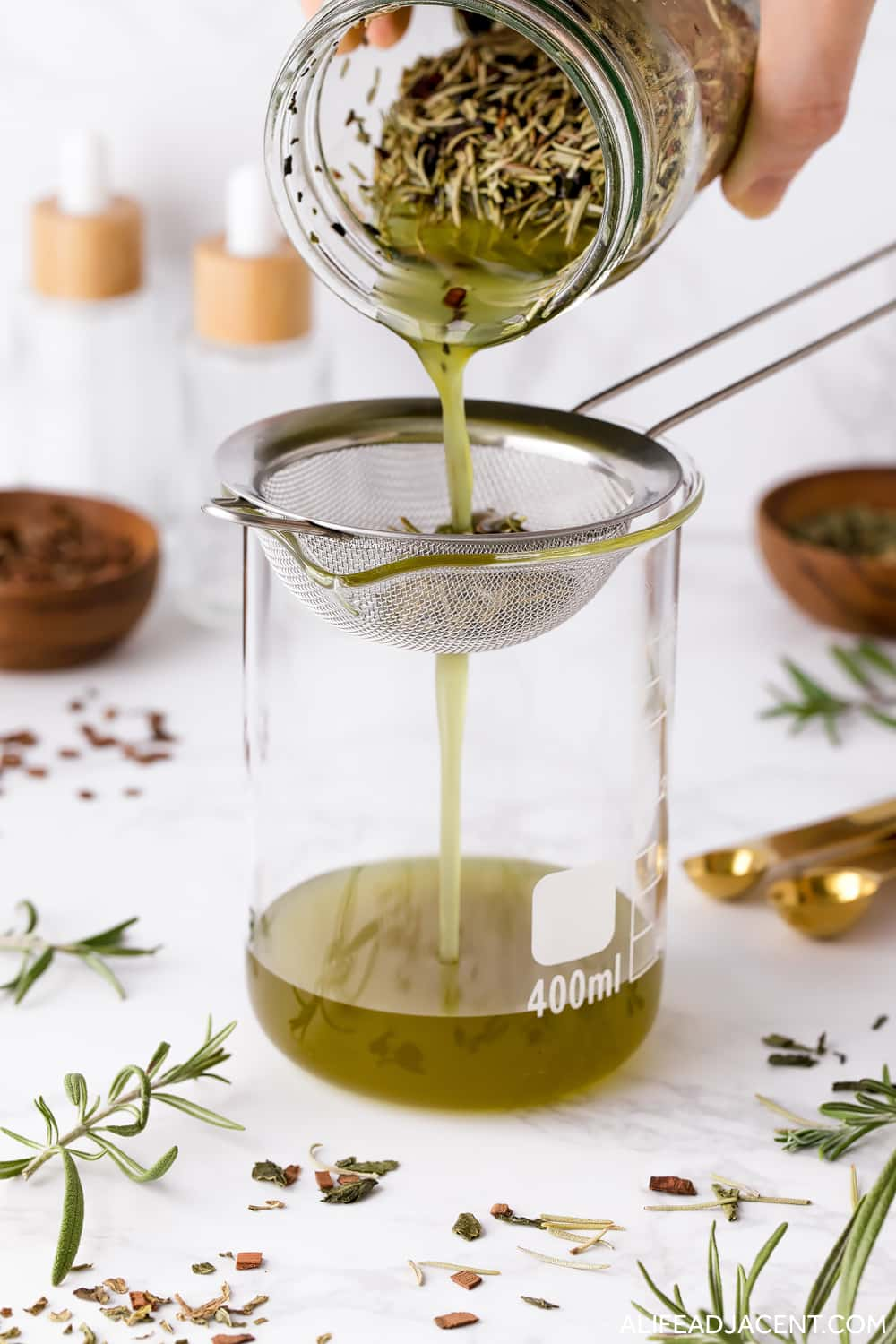
Tip: Be extremely careful, as small pieces of herbs (especially willow bark) can be sharp and may cause splinters. - Following the recipe above, combine equal parts herbal infused oil and castor oil.
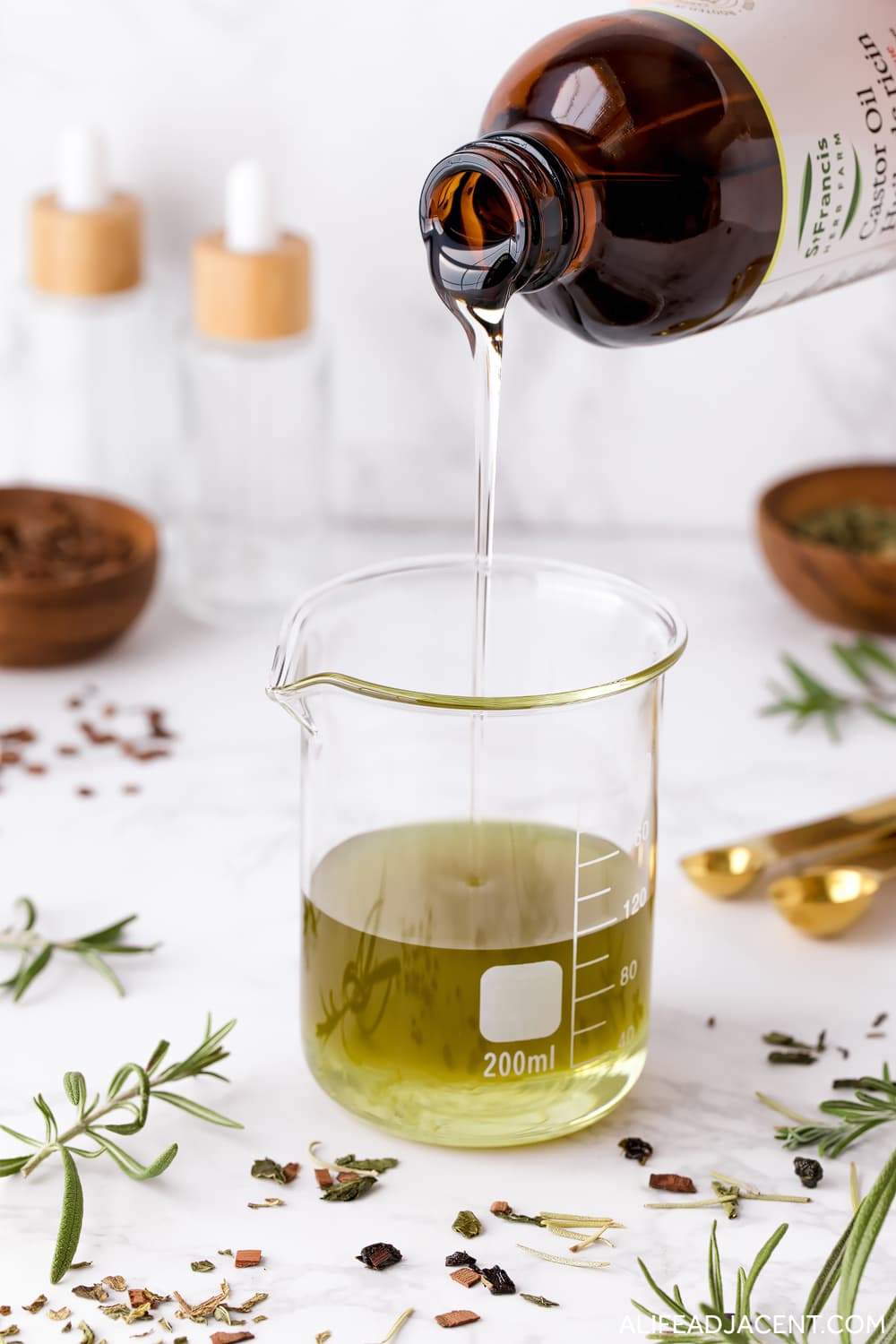
- Add the growth boosting rosemary and peppermint essential oils and mix well to combine.
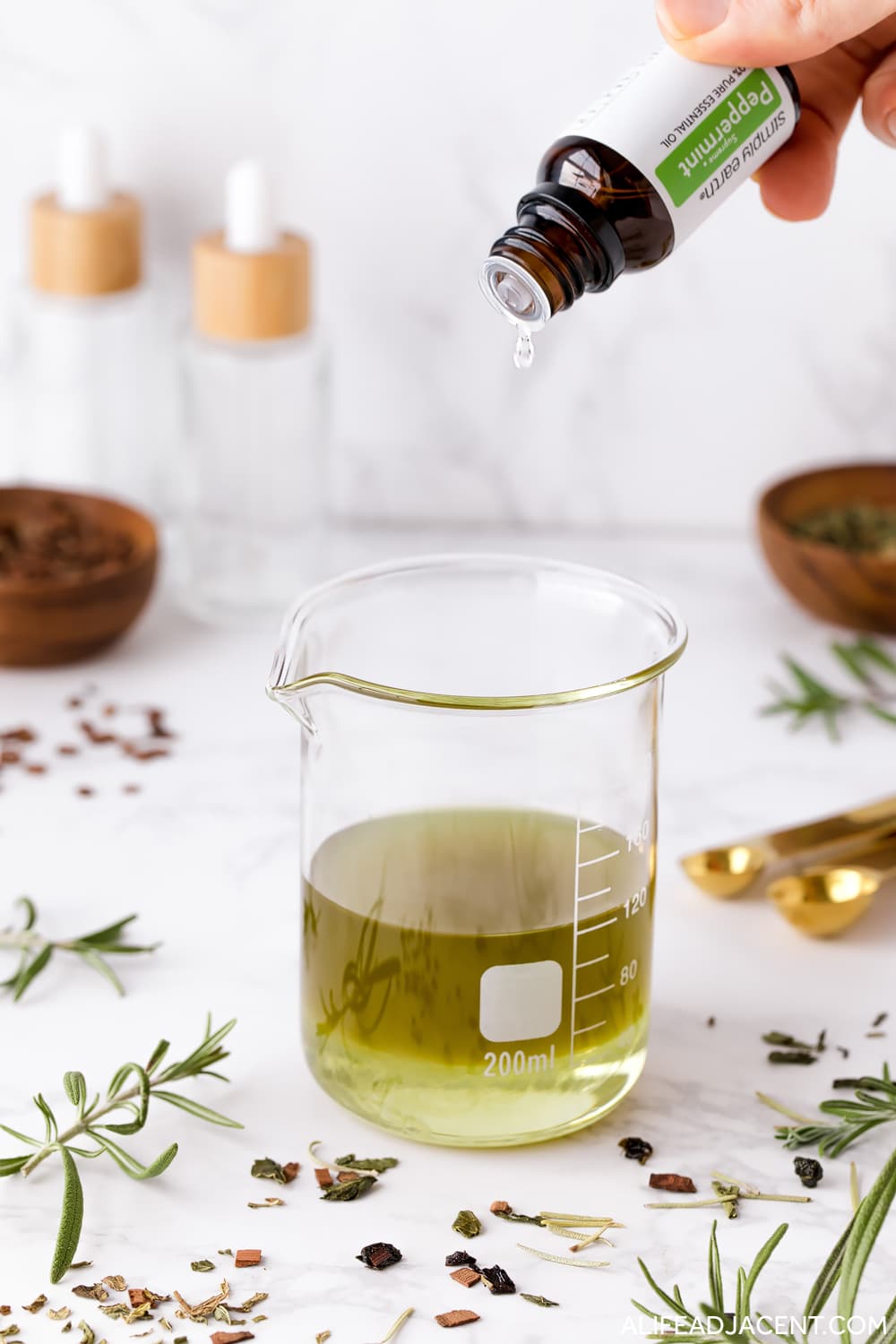
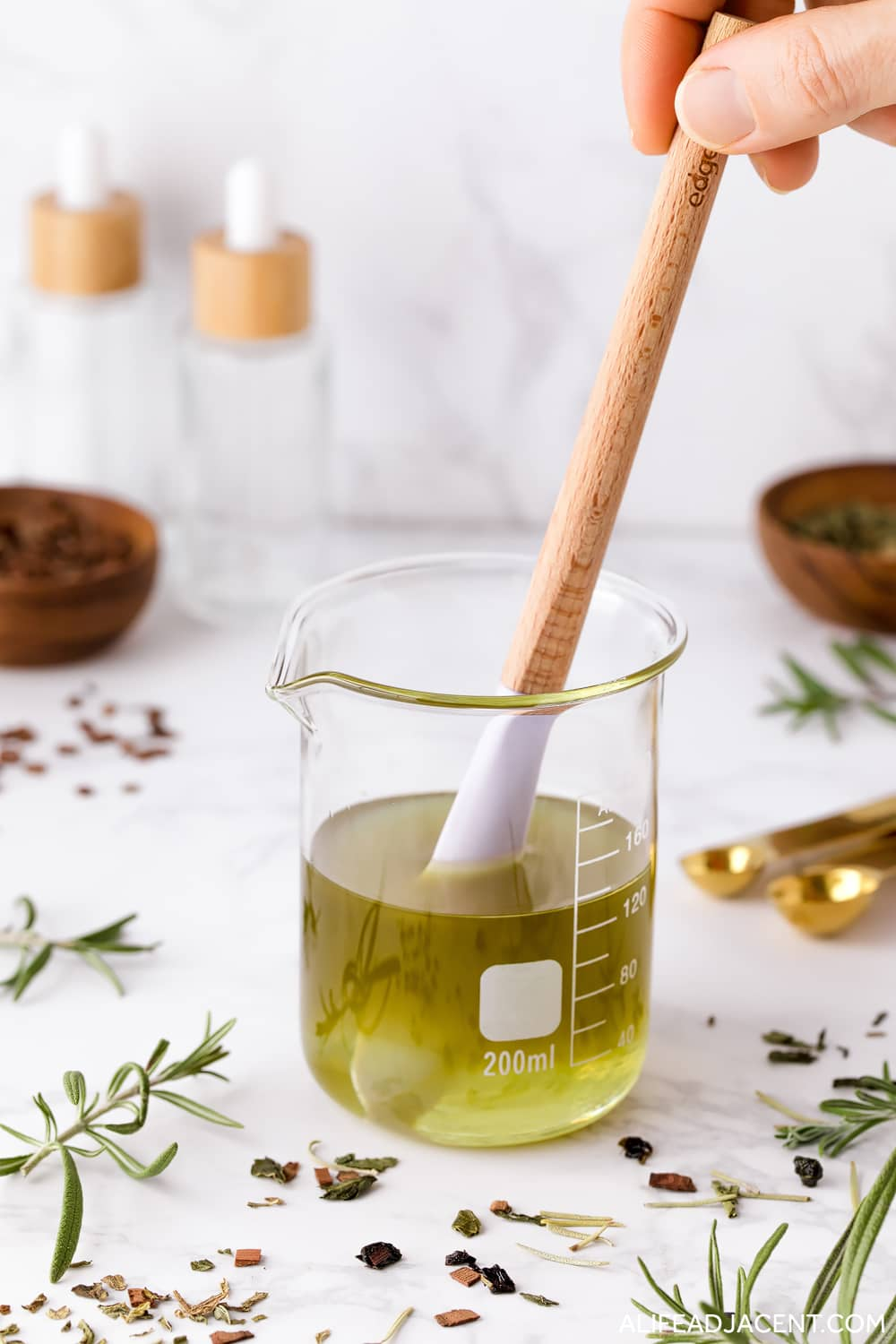
- Transfer the oil to a glass dropper bottle for use.
How to make hair oil with essential oils
- Following the recipe above, combine equal parts castor oil with a low-PUFA carrier oil of choice, such as fractionated coconut oil, jojoba oil, or olive oil.
- Add vitamin E and hair growth essential oil blend and mix well to combine.
- Transfer the hair oil to a glass dropper bottle for use.
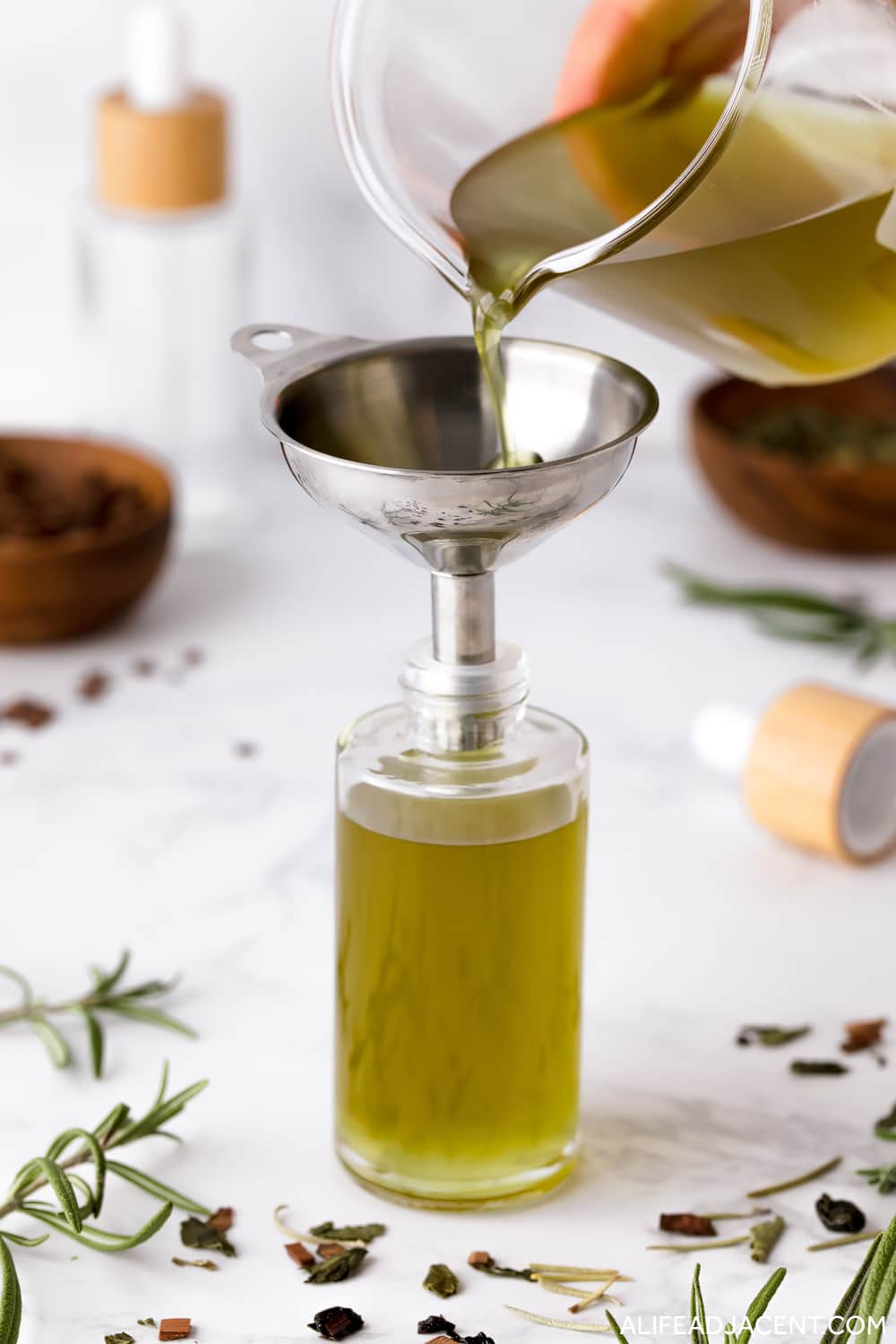
How to use homemade hair growth oil
Using your bottle’s dropper applicator, apply the oil directly to your scalp. Work in sections to ensure you saturate each area of your head evenly.
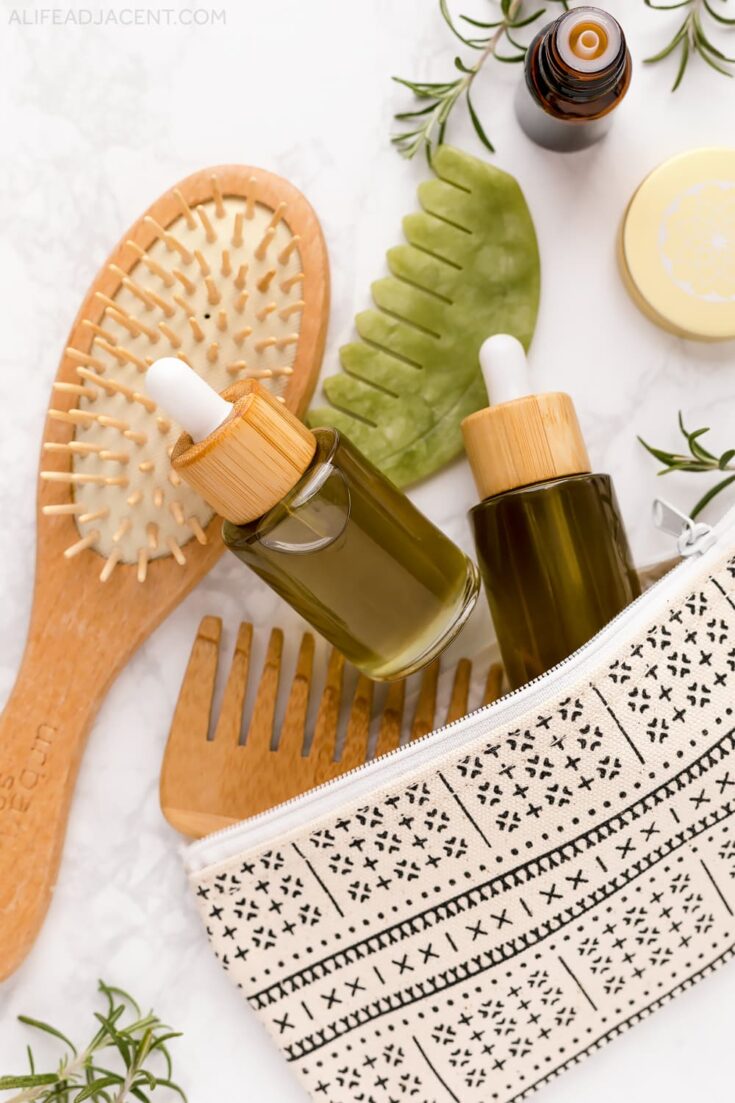
Once you’ve covered your entire scalp in hair growth oil, use your fingers or a massaging comb (such as the jade gua sha comb pictured) to gently massage the oil into your scalp. This stimulates blood flow to the follicles for even better, faster growth results.
If desired, you can also turn your head upside down during the massage (as long as this is safe for you).
Leave the oil on your scalp anywhere from an hour to overnight or even longer, depending on your hair washing routine. Then, wash it out as normal. Please note that using a conditioner before you shampoo is key to washing out castor oil from your hair – more tips below.
If desired, follow with a growth-boosting rosemary hair rinse or a pH-balancing vinegar rinse.
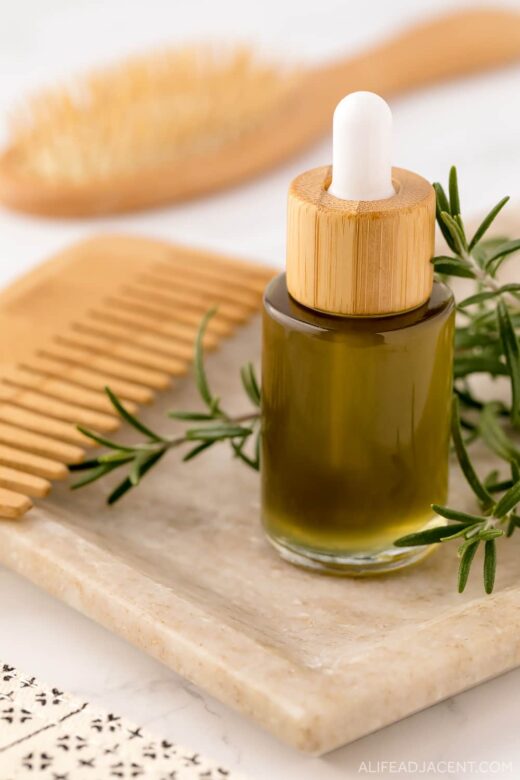
Tips for using DIY hair oil for hair growth
- For best results, use your hair growth oil as often as your lifestyle allows, shortly before you plan to wash your hair.
- The more often you can apply your hair oil, the faster your hair will grow. However, not everyone has the luxury to walk around with an oily scalp all day every day, so oiling your hair and scalp once or twice a week before you wash will suffice.
- Use your hair oil as an opportunity to practice self-care. Spend time intentionally massaging it into your scalp, imagining your hair growing to your desired length. Our thoughts are powerful.
- Gentle heat can help increase scalp circulation. So if desired, you can turn your hair growth oil into a hot oil treatment by gently blow drying your scalp after application. Don’t scorch it though – gentle, low heat for a couple minutes is enough.
- Antioxidants are also beneficial to the hair itself, because the hair cuticle is prone to oxidative damage from heat or environmental factors such as pollution. So you can also spread some of your homemade hair oil down onto the length of your hair to nourish dry ends.
Tips for washing out castor oil from hair
Castor oil is known for its sticky qualities, and it can be incredibly hard to wash out – almost impossible sometimes! But diluting castor oil with another carrier oil (such as MCT oil) makes it far easier to remove.
To avoid a greasy scalp, the best way to wash out castor oil from your hair is to use a conditioner before proceeding with the rest of your wash routine. Conditioners contain emulsifiers that help break up oil, so they’re more effective at washing out castor oil than shampoo alone.
Before you shampoo, massage a generous amount of conditioner into your scalp. I like Derma E Scalp Relief Conditioner, which has menthol, willow bark and other herbs to stimulate growth and soothe a dry, itchy scalp.
Finally, try rinsing with rosemary water as the last step of your hair washing routine. Not only does it boost growth, but it also has clarifying properties that help remove buildup and excess castor oil from your scalp.
DIY Hair Growth Oil for Long, Thick, Luscious Hair Fast
Make this DIY hair growth oil recipe to grow longer, thicker, more luscious hair fast! This natural homemade hair growth recipe is infused with castor oil, herbs, and the best essential oils for hair growth and thickness.
Materials
DIY Hair Growth Oil Recipe
- 47g herbal infused oil (instructions below)
- 47g castor oil
- 3.5ml / 3g peppermint essential oil
- 3.5ml / 3g rosemary essential oil
Herbal Infused Oil
- 1 cup / 200g carrier oil, such as MCT oil, olive oil or avocado oil
- ~3/4 cup dry herbs, such as rosemary, willow bark, peppermint, and green tea
- 5ml / 1 tsp / 4g vitamin E oil
Tools
Equipment
- Digital scale
- Heat-proof glass mason jar lid
- Slow cooker (other methods below)
- Tea towel for even heat distribution
- Laser thermometer
- Sieve or cheesecloth to strain herbs
- Glass dropper bottle
Instructions
How to make hair growth oil
- Place the hair growth herb blend into a clean, heat-proof mason jar. Pour the carrier oil over top to cover the herbs, then add vitamin E oil.
- Use a wooden spoon to mix the contents of the jar, pushing the herbs down until they're evenly covered in oil. Then, seal your mason jar with a metal lid. Make sure it's a one-piece lid to prevent water or steam from leaking inside.
- Prepare your slow cooker by placing a hand towel at the bottom. This prevents the jar from directly contacting the hot bottom, ensuring better heat distribution. Fill the slow cooker with water, adjusting the water level as needed. You want just enough water to submerge the jar without allowing water to leak inside.
- Lower the jar of oil into the water and replace the slow cooker's lid. Using the slow cooker's lowest setting, allow the hair growth oil to infuse anywhere from 8-12 hours.
Tip: Settings vary across slow cookers, so it may be difficult to control the exact water temperature. But to avoid scorching the oil or herbs, try to keep the water temperature between 50°C-71°C (120-160°F). A laser thermometer makes monitoring easy. If the water starts to get too hot, you can remove the slow cooker's lid to offshoot some heat, or turn the unit off altogether. However, MCT oil is very heat stable, so don't panic if you overheat your oil – it's okay to reach a maximum of 110°C (230°F). - Once the herbal oil is finished infusing, allow it to cool before moving on to the next step. If you desire a longer infusion time, simply leave the jar in a cool, dark cupboard to continue infusing.
- Using cheesecloth or a sieve, strain out the herbs from the hair growth oil. Squeeze or press the herbs gently to release as much infused oil as possible. You may need to repeat this process a few times to remove any remaining sediment.
Tip: Be extremely careful, as small pieces of herbs (especially willow bark) can be sharp and may cause splinters. - Following the recipe above, combine equal parts herbal infused oil and castor oil. Add the growth boosting rosemary and peppermint essential oils and mix well to combine. Transfer the oil to a glass dropper bottle for use.
How to make hair oil with essential oils for growth
- Following the recipe above, combine equal parts castor oil with a low-PUFA carrier oil of choice, such as fractionated coconut oil, jojoba oil, or olive oil.
- Add vitamin E and hair growth essential oil blend and mix well to combine.
- Transfer the hair oil to a glass dropper bottle for use.
Notes
Please see the article for a more detailed explanation of this hair oil recipe as well as safety information.
Tips for making hair oil at home
- There are a few steps to making this recipe: making the concentrated herbal infused oil, diluting it with castor oil, and adding the essential oils. The castor oil is added separately to avoid damaging its delicate fatty acids.
- Please use only dried organic herbs for your herbal infusion. Fresh herbs contain water, which harbors mold and bacteria.
- You'll end up with extra herbal infused oil, but you can set it aside for a future batch, or make extra hair oil to gift to a friend.
How to dilute rosemary and peppermint oil for hair growth
- This hair growth oil recipe contains 6% rosemary and peppermint essential oils, or approximately 200 drops (7ml). However, drops are not an accurate measurement, so for best accuracy, please weigh your essential oils with a 0.01g scale.
Packaging, storage, and shelf life
- This recipe makes 100g hair growth oil (approx 1/2 cup or 4oz).
- Glass dropper bottles are best for packaging hair oils, as a dropper makes it easy to apply the oil directly to the scalp. A dark colored glass dropper bottle is preferable to protect the oil from light.
- Use your homemade hair oil within a year for best potency.
Recommended Products
As an Amazon Associate and member of other affiliate programs, we earn from qualifying purchases.


More hair care recipes
For more hair care recipes and hair growth remedies, see also:
- Rosemary Hair Growth Serum Recipe
- DIY Lash Serum for Growth
- Eyebrow Growth Serum Recipe
- Hair Growth Masks with Essential Oils
- Micellar Dry Shampoo Spray
- Micellar Water for Hair
For more natural beauty DIYs, follow us on Pinterest, Instagram, YouTube, Facebook, TikTok, and Twitter.
📌 Pin it for later
- Mysore, Venkataram, and Arpita Arghya. “Hair Oils: Indigenous Knowledge Revisited.” International journal of trichology vol. 14,3 (2022): 84-90. doi:10.4103/ijt.ijt_189_20
- Trüeb, Ralph M et al. “Scalp Condition Impacts Hair Growth and Retention via Oxidative Stress.” International journal of trichology vol. 10,6 (2018): 262-270. doi:10.4103/ijt.ijt_57_18
- Preedy, Victor R., and Ronald R. Watson. “Therapeutic Importance of Caster Seed Oil.” Nuts and Seeds in Health and Disease Prevention, Academic Press, an Imprint of Elsevier, London, 2020, pp. 485–495.
- Panahi, Y., et al. “Rosemary Oil vs Minoxidil 2% for the Treatment of Androgenetic Alopecia: A Randomized Comparative Trial.: Semantic Scholar.” Skinmed, 1 Jan. 1970, https://www.semanticscholar.org/paper/Rosemary-oil-vs-minoxidil-2-for-the-treatment-of-a-Panahi-Taghizadeh/ce0063f1a3c69976833b9daa37deadcba6e71ce8.
- Nematian, Javad et al. “Increased hair shedding may be associated with the presence of Pityrosporum ovale.” American journal of clinical dermatology vol. 7,4 (2006): 263-6. doi:10.2165/00128071-200607040-00008
- Oh, Ji Young et al. “Peppermint Oil Promotes Hair Growth without Toxic Signs.” Toxicological research vol. 30,4 (2014): 297-304. doi:10.5487/TR.2014.30.4.297
- Desborough, M.J.R. and Keeling, D.M. (2017), The aspirin story – from willow to wonder drug. Br J Haematol, 177: 674-683. https://doi.org/10.1111/bjh.14520
- Bassino, Eleonora et al. “Pleiotropic Effects of White Willow Bark and 1,2-Decanediol on Human Adult Keratinocytes.” Skin pharmacology and physiology vol. 31,1 (2018): 10-18. doi:10.1159/000481690
- Kwon, O S et al. “Human hair growth enhancement in vitro by green tea epigallocatechin-3-gallate (EGCG).” Phytomedicine : international journal of phytotherapy and phytopharmacology vol. 14,7-8 (2007): 551-5. doi:10.1016/j.phymed.2006.09.009
- MITSUO KAMIMURA, NAOKO SASAKI, EFFECT OF TOPICAL APPLICATION OF VITAMIN E ON THE HAIR GROWTH OF RABBITS, THE JOURNAL OF VITAMINOLOGY, 1965, Volume 11, Issue 1, Pages 1-8, Released on J-STAGE February 26, 2010, Online ISSN 2185-2553, Print ISSN 0022-5398, https://doi.org/10.5925/jnsv1954.1
- Kuppithayanant, N., et al. “The Effect of Heating on Vitamin E Decomposition in Edible Palm Oil.” Semantic Scholar, 1 Jan. 1970, https://www.semanticscholar.org/paper/The-effect-of-heating-on-vitamin-E-decomposition-in-Kuppithayanant-Hosap/739d503c8cce981faa7b9305574a697676d3b216
- Uronnachi, Emmanuel, et al. “Formulation and Evaluation of Hair Growth Enhancing Effects of Oleogels Made from Rosemary and Cedar Wood Oils.” Scientific African, vol. 16, 2022, https://doi.org/10.1016/j.sciaf.2022.e01223.
- Hay, I C et al. “Randomized trial of aromatherapy. Successful treatment for alopecia areata.” Archives of dermatology vol. 134,11 (1998): 1349-52. doi:10.1001/archderm.134.11.1349
- Di Stefano, Vita et al. “In Vitro Antimicrobial Activity of Frankincense Oils from Boswellia sacra Grown in Different Locations of the Dhofar Region (Oman).” Antibiotics (Basel, Switzerland) vol. 9,4 195. 20 Apr. 2020, doi:10.3390/antibiotics9040195
- Orchard, Ané, and Sandy van Vuuren. “Commercial Essential Oils as Potential Antimicrobials to Treat Skin Diseases.” Evidence-based complementary and alternative medicine : eCAM vol. 2017 (2017): 4517971. doi:10.1155/2017/4517971
- Kregiel, Dorota et al. “Urtica spp.: Ordinary Plants with Extraordinary Properties.” Molecules (Basel, Switzerland) vol. 23,7 1664. 9 Jul. 2018, doi:10.3390/molecules23071664
- Tisserand, Robert, and Rodney Young. “Essential Oil Profiles.” Essential Oil Safety, Elsevier, 2014. Crossref, doi:10.1016/b978-0-443-06241-4.00013-8.
Linda
Tuesday 13th of January 2026
Hello,
I am planning to make the hair growth oil. If I am not able to use heat (slow cooker or stove top), should I still use the two-week cold infusion or should I leave it for a longer time? Thank you
Kyla
Saturday 7th of February 2026
Hi Linda, I sincerely apologize for the delay. Your comment was incorrectly marked as spam. Yes, if you can't use heat, I recommend infusing the hair growth oil for longer, a minimum of 6 weeks to ensure good potency. I hope this helps, and hope you enjoy the recipe!
H
Sunday 18th of May 2025
Hi Kyla,
What if I do not use heat at all!
Can I mix all of these ingredients and just leave them to slowly and naturally infuse for weeks? Would I still achieve the same result? :)
Kyla
Monday 19th of May 2025
Hi H, heat will definitely speed up the infusion process, and may also help make some beneficial compounds in the herbs more soluble, but I don't think it's necessary to get good results. Cold infusion is a very common and effective method for infusing herbs anyway. The hair oil may not turn out exactly the same (and there's no way to know for sure without comparing the recipe made both ways), but I believe you will still achieve a herbal infused oil that helps promote growth. 🙂
Danish
Tuesday 25th of February 2025
Hi Kyla,
Just checking with the slow cooker method. Do you still recommend cold infusion for about 2 weeks after?
Thank you for the great content!!
PS: the last batch (~500 mL) I made using the stovetop method had lasted me about a year, and I’ve been regularly using it after every hair wash.
Kind regards, Danish
Kyla
Thursday 27th of February 2025
Hi Danish, thanks for your kind words, and I'm so happy to hear you've been enjoying the hair growth oil for so long! Yes, I still recommend double infusing for good measure. 😊 It's great to hear your oil lasts so long too – I love being able to make a big batch and not have to worry about it for a while. Thanks for your nice comment and enjoy!
Liz
Saturday 23rd of November 2024
Hi Kyla, Thank you for your informative post. I followed your recipe and been trying the DIY rosemary oil with added fenugreek seeds and cloves (2-3 times a week) & rosemary water (every second day) but I'm noticing my hair sheds, is it normal? Should continue using it or not? I'm freaking out as my hair is already naturally very fine and thin. Although I noticed a few baby hairs are sprouting but the shedding is worrying me. Appreciate your advice. Thank you.
Kyla
Tuesday 26th of November 2024
Hi Liz, I'm sorry to hear you're experiencing this. I think often when we have suffered hair loss or feel our hair is already thin, it can make one be more mindful of every lost hair. I've certainly been there! Some shedding is always normal, and the fact that you've noticed new baby hairs seems like a positive sign. But that said, you know your hair better than anyone. So if you are shedding more hair than usual, this may be a sign to stop doing whatever has worsened the hair fall for you.
Are you experiencing any scalp irritation at all? If so, you may be sensitive to one of the ingredients in the hair growth oil or the rosemary water, and it's never a good idea to keep using something that causes irritation (as this can worsen hair loss).
Personally, my hair has only grown thicker while using my homemade hair growth treatments, and I didn't experience worse shedding, but I also don't believe there's a one size fits all solution for everyone. So to be safe, it may be a good idea to pause using the hair oil + rosemary water and see how your hair reacts. If the shedding stops, this recipe might not be the right fit for you, and you may wish to look into other proven hair growth ingredients such as caffeine (I've been working on some recipes to be published at a later date). I hope this helps and that things continue to improve for you!
Zoë
Wednesday 30th of October 2024
thank you for the recipe!
I want to make the hair oil with jojoba oil, castor oil, rosemary essential oil and peppermint essential oil. How could i add amla oil in the measurements?
Kind regards, Zoë
Zoë
Thursday 7th of November 2024
That's really helpful, thank you so much!
Kyla
Sunday 3rd of November 2024
Hi Zoë, you can use as much amla oil as you'd like as long as you stay within the hair oil recipe measurements. It calls for 94g oil in total (47g each of herbal infused oil and castor oil). So for instance, you could use equal amounts of all 3 carrier oils, and mix approx 31.3g of each.
I've never used amla oil before, so I'm not sure how much you'd typically use in a hair growth oil. But I do know it's not the most heat stable carrier oil, so I recommend adding it later rather than using it to infuse the herbal oil. I hope this helps!