
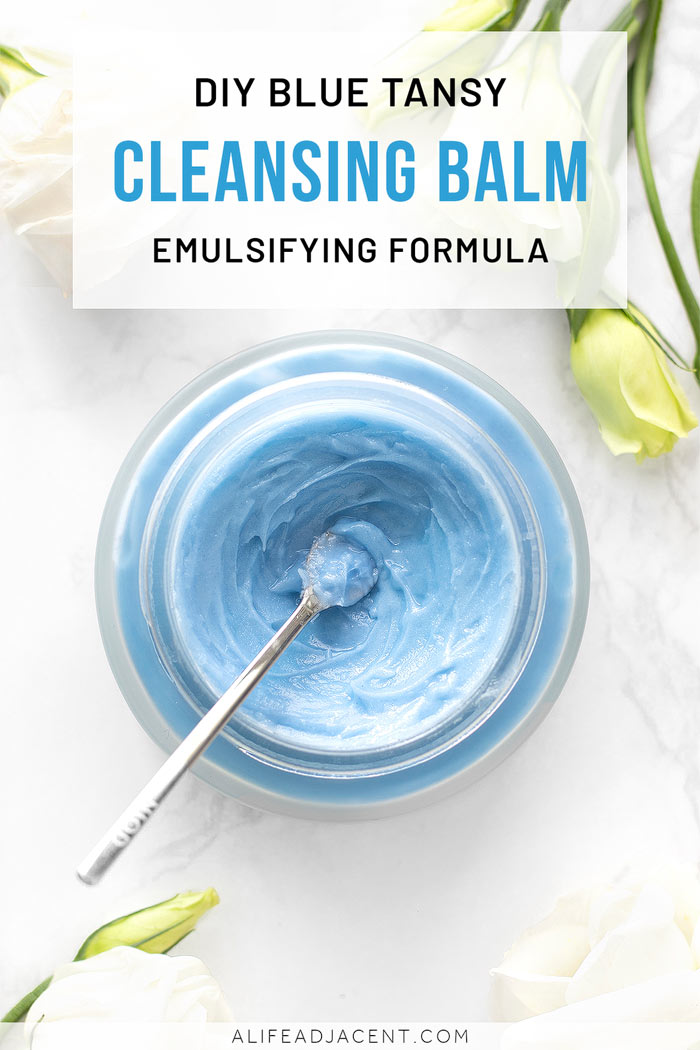
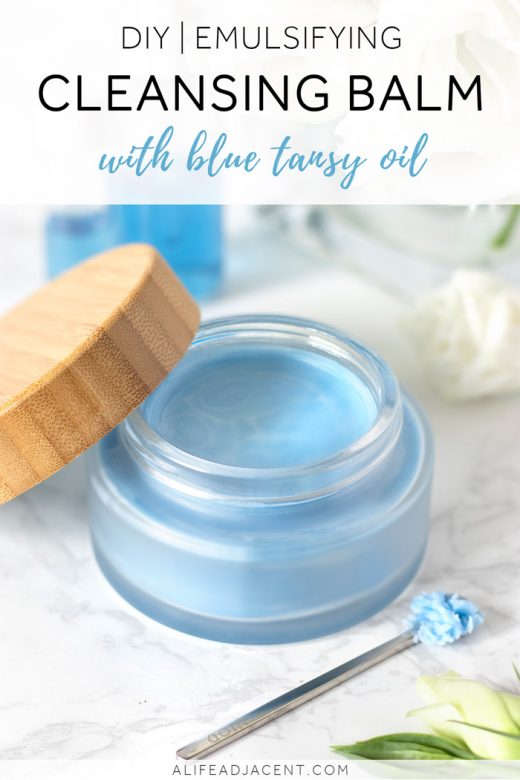
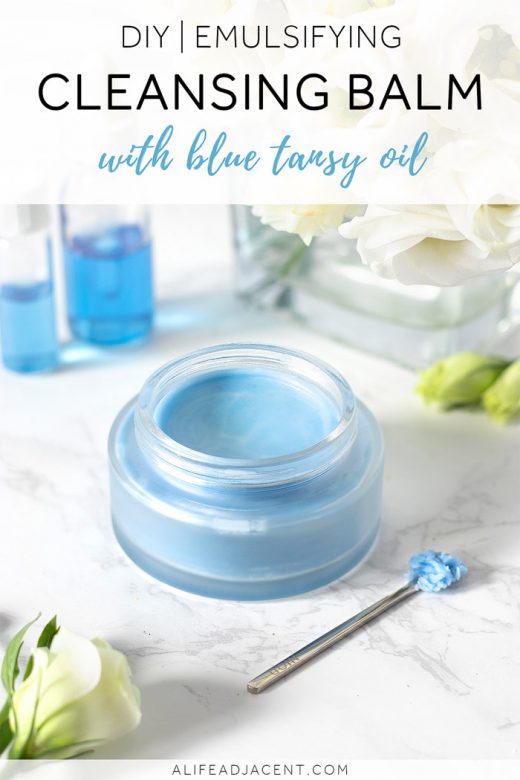
Learn to make a DIY emulsifying cleansing balm with blue tansy oil. This brilliantly blue cleansing balm recipe is a treat for your skin, helping to moisturize and soothe as it melts away makeup. It contains a natural emulsifier for effortless makeup removal. Plus, it’s inexpensive, all-natural, and easy to make in your kitchen, saving you money on expensive brand name cleansing balms.
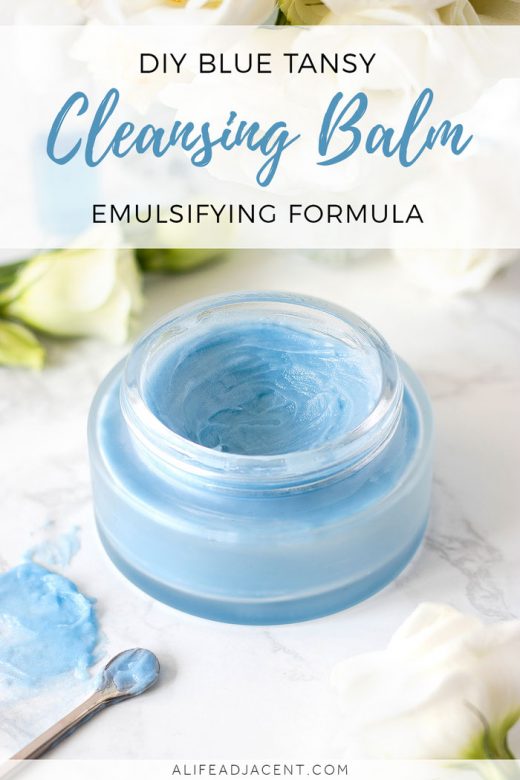
If you’re a skincare connoisseur, you likely know that cleansing balms and blue tansy oil are two of the hottest trends right now. So it only made sense to combine the two for this luxurious emulsifying cleansing balm recipe.
I’m all for splurging on a good, non-toxic beauty product when I feel it’s truly worth it – just not on a product that ends up in the bathroom sink.
That’s why I prefer to make my own makeup removers, and to save the spending for products that really count.
But homemade doesn’t have to mean boring. All you need is a few natural ingredients to make a DIY emulsifying cleansing balm that looks and feels similar to an expensive store bought product.
I already have a simple cleansing balm, but this particular recipe contains a non-toxic emulsifier to truly emulsify your makeup. Blue tansy essential oil adds a beautiful colour and soothing properties, elevating this makeup remover to a spa-like experience.
Before we get into how to make this easy cleansing balm recipe, I’ll guide you through some of its benefits. And if you aren’t inclined to DIY, this multitasking blue tansy balm is the closest store bought alternative.
DIY cleansing balm with emulsifier
Many homemade cleansing balm recipes contain simple mixtures of oils and waxes. And there’s nothing wrong with this if you’re looking for an easy, no-frills DIY makeup remover.
Oil and wax definitely work to emulsify and remove makeup. However, they tend to leave an oily residue behind.
When not followed by a second cleanser, this oily residue can lead to acne and other skin issues. This is why the oil cleansing method can cause problems for some people, which I go into more detail about in my post on DIY cleansing oil.
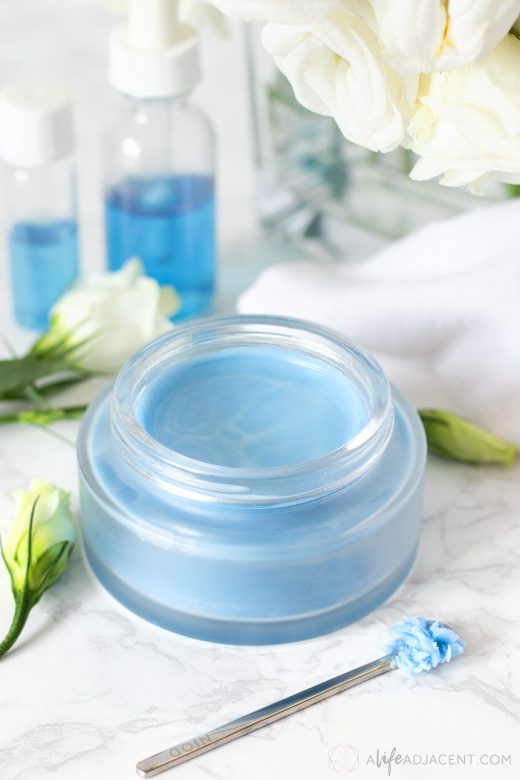
This cleansing balm is different from most recipes. It quickly and easily melts away makeup, and after cleansing, it wipes off clean with minimal residue.
This is made possible by one of my favourite naturally-derived emulsifiers, which I’ll reveal more about in a moment.
Benefits of blue tansy essential oil for skin
From this soothing facial oil to this opulent skin balm, blue tansy essential oil is everywhere.
And for good reason – besides the gorgeous azure colour that it imparts to products, blue tansy oil has a multitude of skin benefits.
Of all the blue essential oils, such as yarrow, cypress, and chamomile, blue tansy is the bluest of all. This is because it has the highest concentration of the anti-inflammatory compound chamazulene.
Chamazulene is a potent antioxidant that helps scavenge free radicals and inhibit lipid peroxidation. It has also been shown to have anti-allergy, anti-inflammatory, and analgesic activity.
In theory, this means that blue tansy oil could help skin conditions linked to inflammation, such as rosacea, eczema, and acne, according to dermatologist Dr. Yoram Harth. However, the evidence is not yet conclusive.
Aside from its uses for skin, blue tansy essential oil also has aromatherapeutic benefits. Its bright, herbaceous scent helps lessen anxiety and promote a sense of calm.
For this reason, using blue tansy products can help you relax while you care for your skin.
Some of the best skincare products with blue tansy oil:
- Herbivore Lapis Balancing Facial Oil
- Acure Seriously Soothing Blue Tansy Night Oil
- Herbivore Blue Tansy Resurfacing Mask
- Acure Seriously Soothing Blue Tansy Solid Serum
- The Yellow Bird Balancing Blue Tansy Face Oil
- Handmade Blue Tansy Tallow Balm

Ingredients for DIY emulsifying cleansing balm
Blue tansy essential oil
A few drops of calming blue tansy oil adds a soothing aroma and turns this cleansing balm a beautiful shade of blue.
To be safe, I kept the concentration of blue tansy oil in this recipe low. If you have very sensitive skin, you may even wish to omit it completely.
You should always exercise caution when using skincare products that contain essential oils. All essential oils have the capacity to irritate skin, even those that are purported to be soothing.
If irritation develops, always discontinue use and consult your doctor or dermatologist.
As well, always make sure to get your essential oils from reputable sources. I like this particular brand of blue tansy oil.
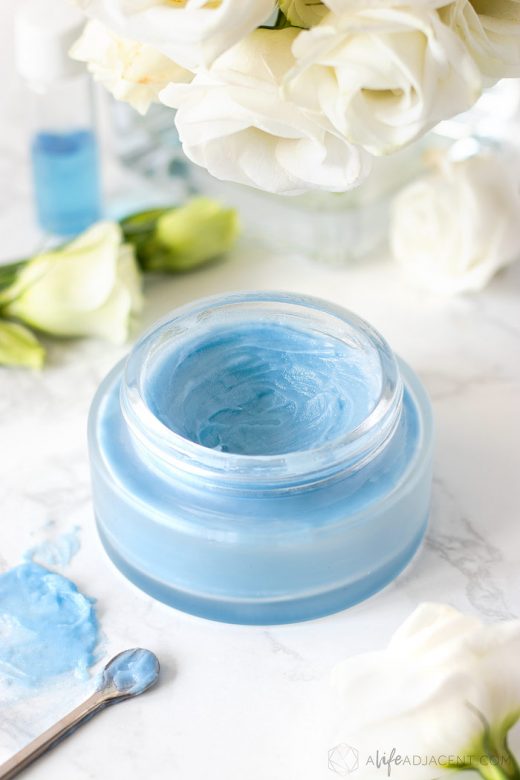
MCT oil (Capric/caprylic triglycerides)
You might know MCT oil as a ketogenic diet aid, but a lesser known fact is that it’s a great skincare oil, too.
MCT oil is derived from coconut or palm oil. However, MCT oil does not have the same comedogenic qualities as those oils.
The fractionation process, which separates fatty acids, reduces MCT oil to only two fatty acids: capric acid and caprylic acid.
Not only does fractionation make MCT oil liquid at room temperature, but it also makes it tolerable to a wider range of skin types.
That’s why capric/caprylic triglycerides are used in so many dermatologically-approved skincare products.
Capric and caprylic acid have antibacterial properties, so they’re unlikely to exacerbate acne. Yeast on the skin also won’t eat them, making topical MCT oil safe for those with fungal acne and issues like seborrheic dermatitis as well.
I like using MCT oil in DIY skincare products because it’s completely saturated. It lacks unsaturated fatty acids, meaning it has a very long shelf life.
MCT oil also won’t oxidize in the presence of heat, which is important since I recommend removing this emulsifying cleansing balm with a hot, wet washcloth.
White beeswax
Beeswax is a great alternative to texture-enhancers such as petroleum and silicones, which can be problematic for some skin types.
In this recipe, beeswax helps emulsify while creating a smooth and velvety consistency. But aside from its thickening properties, it also helps moisturize and nourish skin.
Even if you have sensitive skin, beeswax can still work for you. I used triple-filtered white beeswax for this emulsifying cleansing balm, which is far less allergenic than regular yellow beeswax.
If you’re severely allergic to bee products or simple wish to avoid them for ethical reasons, candelilla wax or sunflower wax are good vegan alternatives.
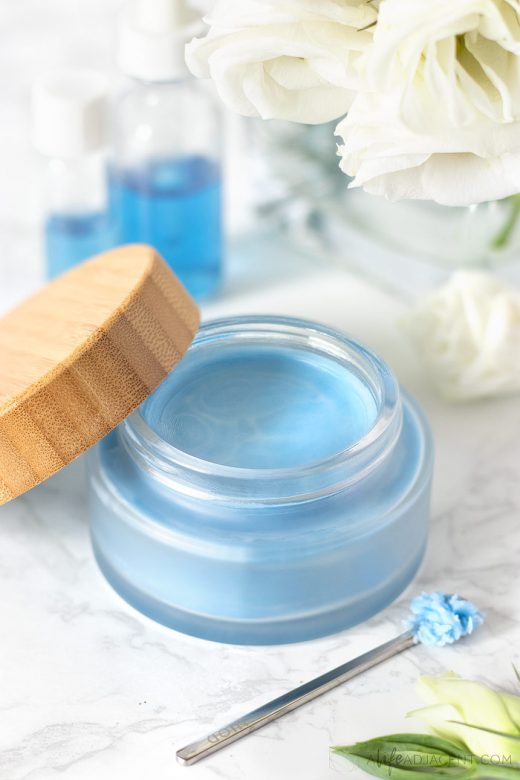
Olivem 1000
Olivem 1000 (also called olive emulsifying wax) is a PEG-free, naturally derived mild surfactant and emulsifier.
True to its name, it’s made from olive lipids, and its high fatty acid content helps to nourish and condition the skin.
I like Olivem 1000 for many reasons, one being how simple it is to use. It’s made of waxy flakes that are easily melted and incorporated into a product, helping to thicken and enhance texture.
Olivem 1000 has a rich, silky skin feel, but it’s also very viscous. As a result, you’ll need a hot washcloth to remove the balm.
Vitamin E oil
Adding vitamin E is optional, but I chose to include it for its potent antioxidant properties.
Chamazulene is unstable and begins oxidizing when exposed to air. Over time, this process causes blue tansy oil to turn from bright blue to green. Vitamin E’s antioxidant capacity helps slow down this process.
It’s important to watch your essential oil’s colour. Once blue tansy oil turns green, it’s been oxidized, meaning it’s no longer safe to use.
Spoiled essential oils can cause a host of unpleasant effects, including skin rashes and burns. For more information, see this article on oxidized essential oil dangers.
Blue spirulina powder
To deepen this cleansing balm’s azure colour without adding too much essential oil, I opted to add blue spirulina powder.
I chose blue spirulina solely for its colour, but it turns out that the pigment responsible for its bright hue, phycocyanin, also has anti-inflammatory and antioxidant properties.
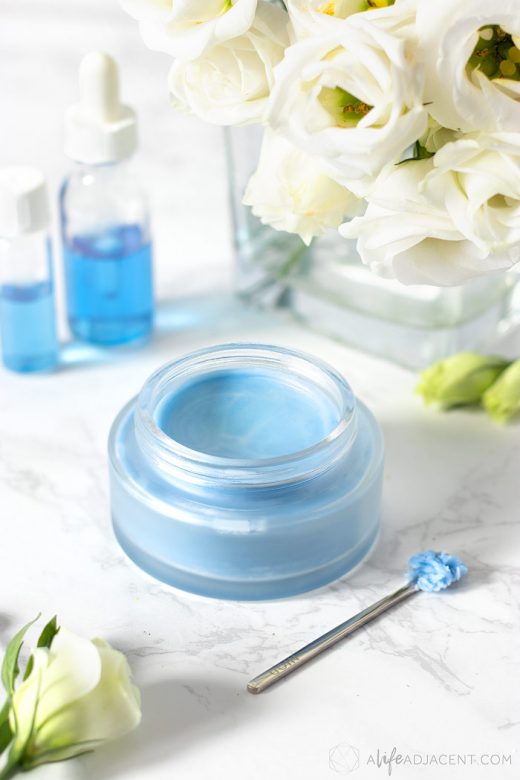
How to make DIY emulsifying cleansing balm
For detailed instructions and ingredient measurements, please consult the recipe card at the bottom of this post.
- In a small double boiler or Turkish coffee pot, begin by melting Olivem 1000 and your wax of choice on medium heat.
- Then, add the MCT oil. Once the mixture is completely liquified, turn off the heat.
- Whisk in the blue spirulina powder and let the balm cool for a few minutes.
- Add the vitamin E oil and blue tansy essential oil and whisk to incorporate.
- Pour the cleansing balm into a glass jar. (A Turkish coffee pot’s lip makes this easy.) Replace the lid on the jar and place the balm into the refrigerator to harden for about 30-40 minutes.
How to use your emulsifying cleansing balm
To use your balm, start with dry skin.
Scoop out a generous amount with a clean cosmetic spoon. If using your fingers, make sure they are clean and dry, as introducing water into your balm can cause bacteria and mold to grow in the jar.
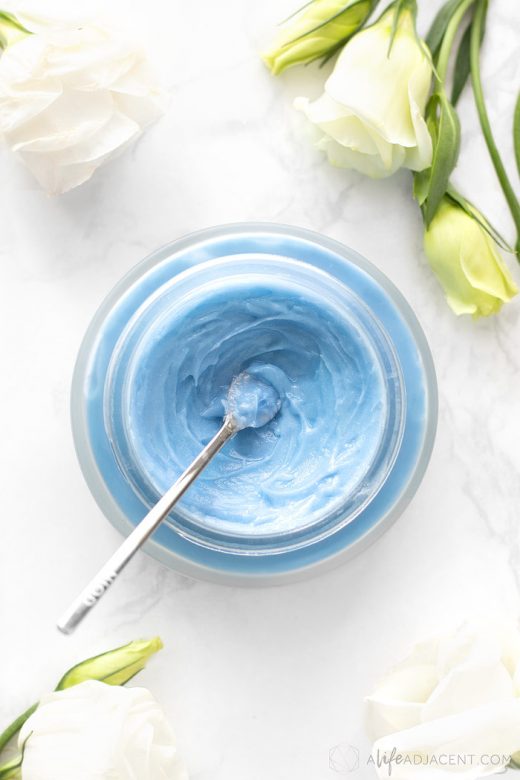
Massage the cleansing balm into your skin with gentle, circular motions until your makeup is milky and emulsified.
This is also a great opportunity to give yourself a facial massage to encourage circulation and lymphatic drainage. You could even use a gua sha tool at this time, as the cleansing balm provides a slick surface for it to work.
To remove the balm, soak a washcloth in hot water and place it over your face for a few moments. Then, gently glide the cloth across your skin to remove all traces of makeup.
You may need to repeat this step more than once. Be gentle and don’t tug, especially around the delicate eye area.
Once your skin looks visibly clean, follow it up with a second cleanser to remove any residue.
I recommend a gentle one such as this ceramide cleanser or natural micellar water. You could even make your own micellar water with my DIY recipe.
Or, if you’re looking for a homemade cleanser that rinses clean with no residue, you might like my emulsifying cleansing oil recipe.
I recommend using this balm at night to remove makeup, not as a morning cleanse. In the morning, a gentle cleanser or splash of water is likely enough.
It’s important not to disrupt your skin’s moisture barrier any more than you need to. But even if you don’t wear makeup, this cleansing balm is a great way to nourish dry, sensitive skin while giving yourself a bit of extra self-care.
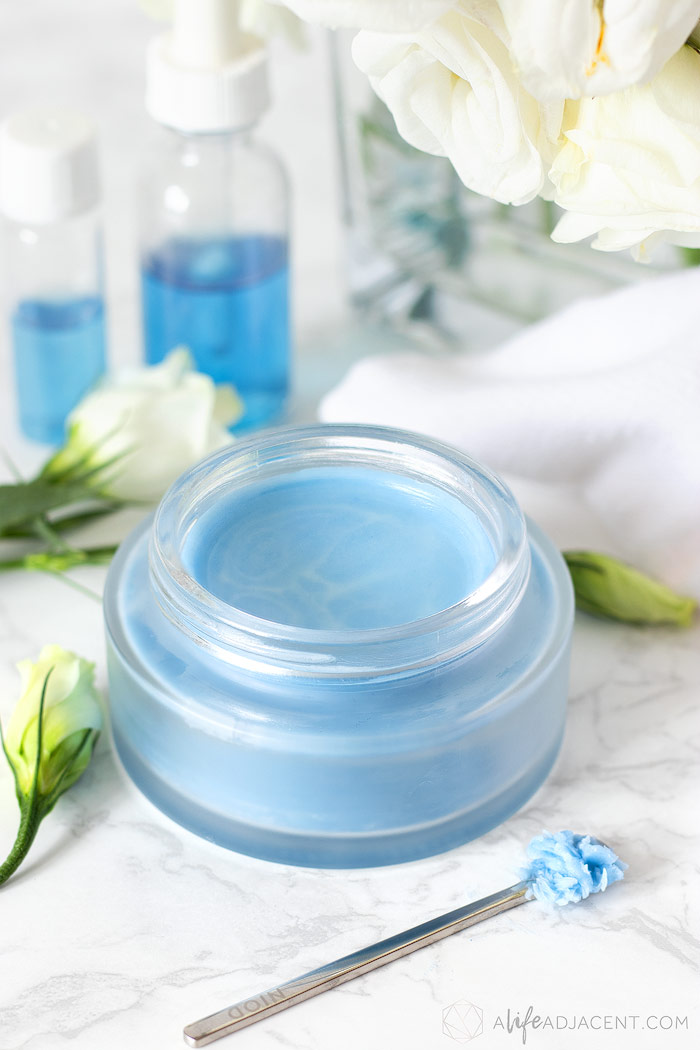
Equipment
- Small double boiler or turkish coffee pot
- Glass jar with lid
- Small whisk
Ingredients
- 1/2 cup
capric/caprylic triglycerides or MCT oil - 2 tbsp
white filtered beeswax pellets see vegan substitutions below - 1 tsp
Olivem 1000 - 10 drops blue tansy essential oil
- 1/4 tsp
vitamin E oil optional - 1 tsp
blue spirulina powder optional
Instructions
- In a small double boiler or turkish coffee pot, begin by melting Olivem 1000 and your wax of choice on medium heat.
- Once the two have melted, add the MCT oil. The wax may re-solidify at this point, so whisk until any clumps have dissipated. Once the mixture is completely liquified, turn off the heat.
- Whisk in the blue spirulina powder and let the balm cool for a few minutes.
- Add the vitamin E oil and blue tansy essential oil and whisk to incorporate. If the mixture begins to harden, place it briefly over the lowest possible heat and mix until liquified. Only use low heat as to not damage the fragile essential oil.
- Pour the cleansing balm into your glass jar of choice. (A Turkish coffee pot’s lip makes this easy.) Fasten the lid on the jar and place it in the fridge to harden.
Notes

More cleansing balm recipes
If you enjoyed this recipe, you might also like these other homemade cleansing balms:
- DIY Exfoliating Cleansing Balm with Papaya Enzymes
- Lavender Cleansing Balm Recipe
- Simple DIY Makeup Remover Balm
- DIY Chocolate Cleansing Balm at Soap Deli News
And if you’re looking for more makeup removers that you can make at home, check these out:
- Natural DIY Micellar Water with Witch Hazel
- 2-Ingredient Cleansing Oil Recipe
- Green Tea Cleansing Oil
For even more natural DIY skincare recipes, follow us on Pinterest, Instagram, YouTube, Facebook, TikTok, and Twitter.
Pin it for later
Lacey
Saturday 7th of June 2025
Hi Kyla!
I followed your recipe to the letter, and it turned out beautifully! As an aesthetician w/ 20 yrs in clinical skincare (ie chemical skincare), I haven’t reached for one of my $60 cleansers since!
I’ve also been trialing it in the treatment room, and my clients are loving it!
The only difference was that mine turned out a richer ocean blue—but honestly, I’m not mad about it!
By request, I just launched a small batch in my Etsy shop—here’s the link if you’d like to check it out!
Thank you for all your inspiration! I hope you’ll keep sharing your recipes—I’d especially love to see some more all-organic skin serums in the future! 🙏
Your devoted follower, Lacey
Lacey
Friday 28th of March 2025
Hello! If I wanted a pink color instead of the blue, could I substitute the blue spirulina powder for passionfruit power? It says just passionfruit powder-no additives.
I noted your recommendation for a cosmetic scale in other recipes, is a food scale ok?
How soon does blue tansy essential oil usually oxidize? I use young living’s if that helps!
Thanks, Lacey
Lacey
Monday 21st of April 2025
@Kyla, Hello again, I’m still a little unsure about only subbing oil-soluble products for the blue spirulina for color in this recipe…isn’t the phycocyanin in the spirulina also water-soluble? Just asking so can fully wrap my mind around what works & what doesn’t for future recipes😊 Also, if I wanted to forgo the blue tansy theme & try to incorporate rose…do you have any recommendations/alterations for the recipe? I had luck with the Alkanet root MCT infusion for a pink tint so I was thinking I could use some in place of the MCT oil in the recipe. Thank you so much for all your support! Lacey
Lacey
Sunday 6th of April 2025
@Kyla,
Hi Kyla!
Thank you so much for your thoughtful responses—I really appreciate your time! And sorry for making you repeat yourself, I got a little carried away and completely forgot what I’d already asked!
I recently picked up some alkanet root powder for color (thank you for clearing up the oil vs. water-soluble question!). Do you think it’ll work well? And whether I use the beetroot or alkanet powder, would it be best to infuse it into the coconut oil over low heat, then strain it to avoid a grainy texture?
Also—thank you for the blue tansy tip! That tiny 5ml bottle cost me over $100, and I had no idea about the proper storage or how to test for rancidity.
—Lacey
Kyla
Tuesday 1st of April 2025
Hi Lacey, the passionfruit powder sounds lovely but as a water-soluble pigment, it unfortunately won't disperse into an oil-based product like a cleansing balm.
I mentioned some pink colorant options in my responses to your other comments, so I'm sorry for repeating myself, but I'll just mention them again for anyone else who might be reading this comment and looking for the same information. 😊
MakingCosmetics pink beetroot extract pigment and ColorKitchen pink food coloring powder are great oil-soluble options for coloring homemade beauty products pink.
As for the scale, it depends on the quantities called for in the recipe. Many food scales measure down to 0.1g only, which is fine for most of the skincare recipes on our site, but isn't precise enough to measure very small quantities.
If you need to measure a minuscule amount of something, say 0.05g of an essential oil for instance, you'll need a scale with 0.01g precision to ensure accuracy.
To answer your last question, an opened bottle of blue tansy essential oil can oxidize within 1-2 years at room temperature due to its high chamazulene content, but keeping it cold can help slow down this process. I keep my blue tansy oil in the fridge and try to use it within 1-2 years to be safe, watching for color or scent changes. If it turns green, it's definitely done.
I hope this all makes sense, and please let me know if I can help further! Also, thanks for reading and for leaving such nice and engaging comments. I appreciate that you've taken the time to read so many of our recipes, and very happy to know you're considering making them. 😊
Leann
Friday 8th of September 2023
Not so much a comment as a question, I’m allergic to Coconut most it’s derisive what oil can I use in place of the MCT?
Kyla
Monday 11th of September 2023
Hi Leann, jojoba oil, castor oil, olive oil or avocado oil are other good alternatives that would work well in this recipe.
Basically, the only oils I wouldn't recommend using in a cleansing balm are high-PUFA oils such as sunflower, safflower, sweet almond, soybean, etc, as these ones are very unstable and don’t hold up well to heating.
If you're allergic to coconut derivatives you might also be able to find MCT oil derived from palm oil. Squalane is another good one too, derived from olives or sugarcane. I hope this helps!
Haben
Friday 2nd of June 2023
I just found your site and I’m loving all of your skincare recipes. I love that you explain why you use each ingredient and even offer substitutions.
I’d love to know how much each recipe makes in terms of How Big of a Container I will need to put the finished product into.
Your recipes are so lovely and seem well thought out.
Thank You in advance. Haben
Kyla
Sunday 4th of June 2023
Hi Haben, that is so nice to hear, and I'm so glad you're enjoying our recipes. Thank you for the kind words!
This cleansing balm recipe makes about 150g, so you could use a 150g jar or a couple of smaller jars. For instance, the frosted glass and bamboo jars pictured in this post come in 100g and 50g sizes (you can find the jars here).
If it's easier, you can also half the recipe. That way, it will fit in a standard 100g jar or a small 4oz mason jar.
I'm sorry for any confusion – this recipe is from years ago before I started publishing recipes by weight. I'm in the process of updating some of my older recipes to make the measurements more clear, but I have a long to-do list for the blog so it's taking me a while to update each one.
Thanks again and please let me know if you have any more questions!
Amber
Sunday 21st of November 2021
Hello, I love this wonderful recipe, I wanted to ask you if there is a way to convert this balm like the one from Farmacy and its famous Clean Balm that melts with contact with water. Thanks
Kyla
Monday 22nd of November 2021
Hi Amber, so glad you like it! If you're looking for a cleansing balm recipe that rinses easily with just water, you might enjoy my lavender cleansing balm or papaya cleansing balm. Both use a different water-soluble emulsifier than this recipe, and work similarly to store bought cleansing balms.